 English
 Russian
 Arabic
 Indonesian
 Turkish
 Vietnamese
 Polish
 German
 Malay
Malay Thai
Thai Kazakh
 Spanish
 Chinese (Simplified)
 Korean
 Italian
 Azerbaijani
 Dutch
Dutch French
 Romanian
 Portuguese
 Hindi
HindiQuick Answer
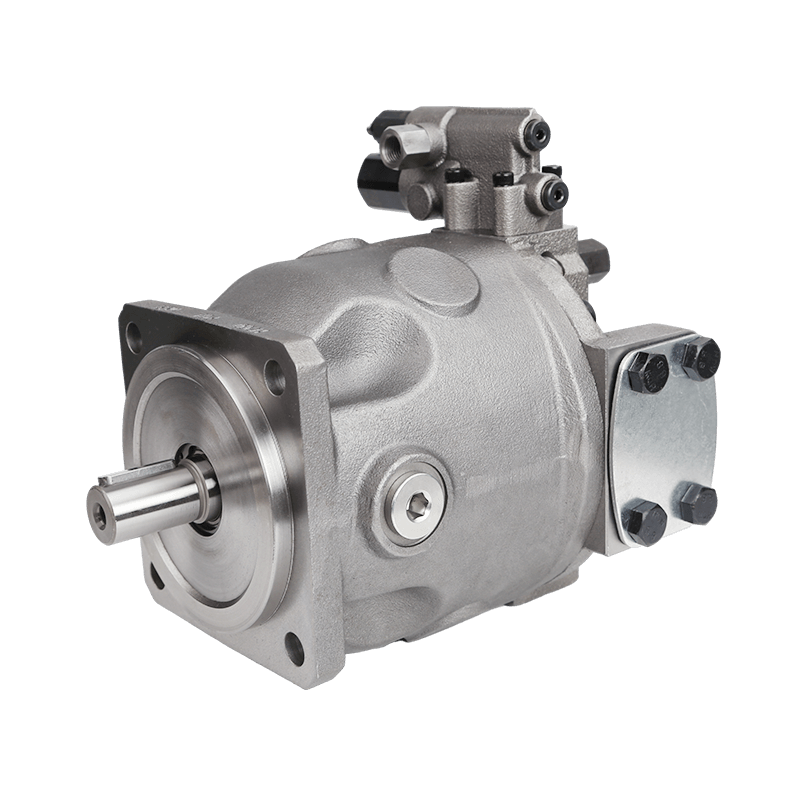
A10VSO pump control selection should start with the function required by the hydraulic circuit. For A10VSO Series 31, DG provides direct two-point control; DR provides pressure control; DRG provides remotely operated pressure control; DFR and DFR1 combine pressure and flow control; DFLR adds power control; and ED or ER provides electrohydraulic pressure control. The correct choice depends on the machine schematic, control signal, pilot connections, and required response—not just pump size or appearance.
POOCCA supplies compatible replacement pumps for Bosch Rexroth A10VSO applications. They are not original Bosch Rexroth products. When evaluating an A10VSO compatible replacement pump, confirm the complete model code and identify how the existing control interacts with the valve system before ordering.
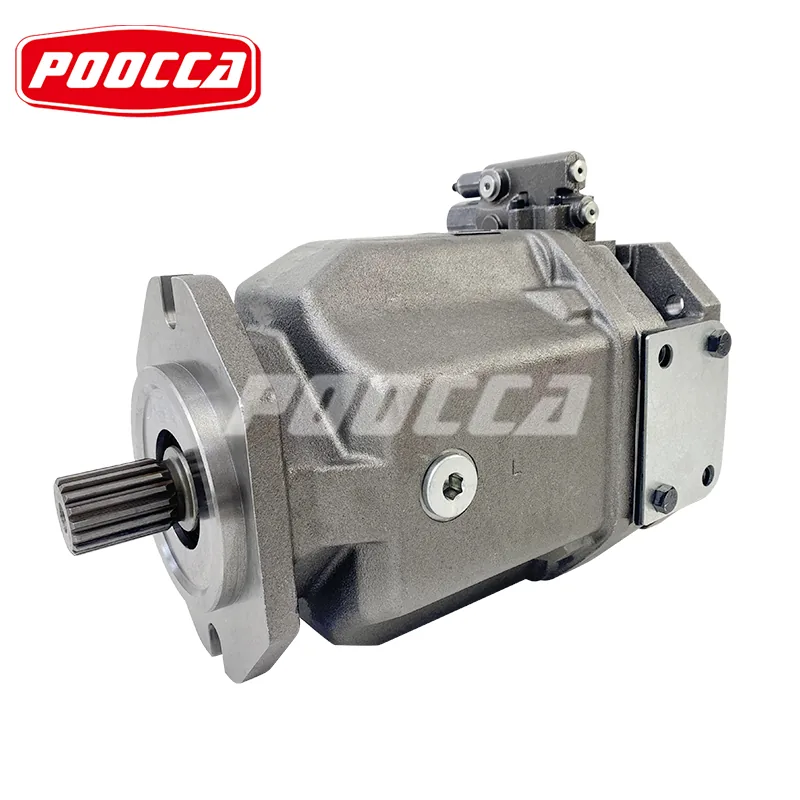
Why the A10VSO control code matters
The control changes how the swashplate responds when system pressure, requested flow, or an external signal changes. Two pumps with the same nominal displacement can therefore produce very different standby behavior, response, and drive loading. A mounting match does not correct a control mismatch.
Before comparing codes, define what the circuit must do. Does it require two displacement positions, constant pressure, remote pressure adjustment, load-sensing flow control, power limitation, or an electrical pressure command? Then trace the related pilot lines, metering elements, remote valves, and electrical signals on the machine schematic. This functional check is the core of A10VSO pump control selection.
A10VSO Series 31 control comparison table
| Control code | Main function | Suitable system requirement | Connections or information to verify | Main selection risk |
|---|---|---|---|---|
| DG | Two-point control, directly operated |
Commanded switching between maximum and minimum displacement | Port X, available switching pressure, operating pressure, and switching logic | Mistaking DG for proportional flow control |
| DR | Pressure control | Maintain a selected pressure while supplying demanded flow | Pressure command, standby behavior, and circuit protection | Assuming the controller replaces system relief protection |
| DRG | Remotely operated pressure control | Pressure adjustment through a separate remote pilot valve | Port X piping, remote valve, pilot flow, and settings | Ignoring the external pilot circuit |
| DFR | Pressure and flow control; X–T connection open | Load-sensing flow control with pressure limitation | LS signal, metering element, differential setting, and open X–T path | Substituting DFR1 without checking LS unloading |
| DFR1 | Pressure and flow control; X–T connection closed | Load-sensing system that unloads the LS pilot line through the valve system | Closed X–T path and confirmed LS unloading route | Trapping the LS signal and causing incorrect response |
| DFLR | Pressure, flow, and power control | Load-sensing control with pump power management | Power characteristic, speed, pressure, flow, and size availability | Specifying it for size 18 or without a defined power requirement |
| ED | Electrohydraulic pressure control | Electronically commanded pressure control with the required ED response | Exact ED version and machine control documentation | Assuming ED and ER have the same command behavior |
| ER | Electrohydraulic pressure control | Electronically commanded pressure control with the required ER response | Exact ER version and machine control documentation | Selecting from connector appearance instead of the complete code |
When to choose DG
DG is a two-point control, directly operated. An external switching pressure at port X moves the Series 31 pump between maximum and minimum displacement. Choose it only when the machine deliberately uses this two-position behavior. Confirm the available switching pressure and its relationship to operating pressure at port B. DG is not the correct choice when the circuit needs continuously modulated load-sensing flow.
When to choose DR
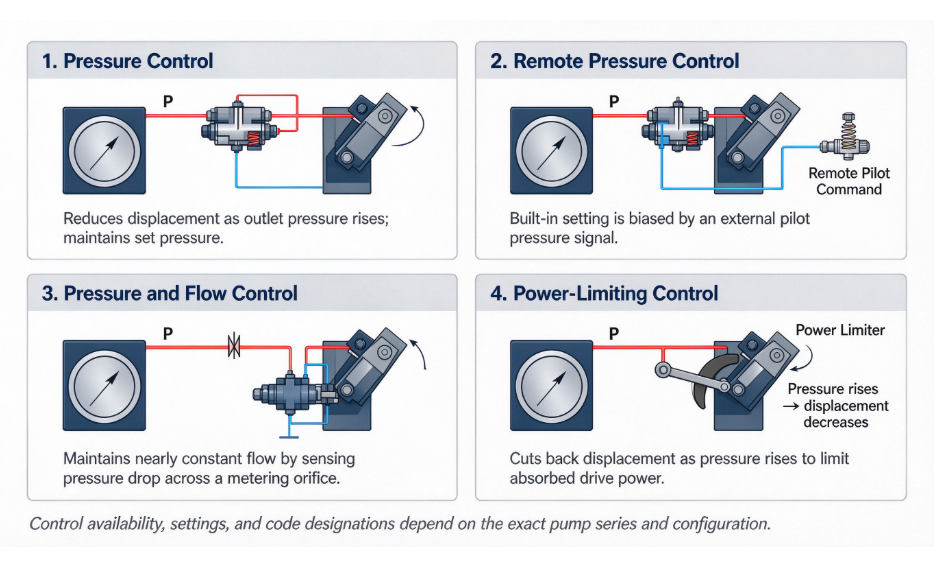
DR is pressure control. As outlet pressure reaches the selected command, the pump reduces displacement and supplies only the flow still demanded by the circuit. It suits systems that require pump pressure regulation without a separate remote pressure command. Verify the intended pressure setting, standby behavior, duty, and system protection. The pump controller must not be treated as a replacement for the pressure-protection devices required by the machine design.
When to choose DRG
DRG is remotely operated pressure control. A separately installed pressure valve connects to port X and influences the pump pressure command. Select DRG when remote pressure adjustment or unloading is part of the approved circuit. The external valve, piping, pilot-flow requirement, and settings are functional parts of the design. A DRG pump should not be ordered from the pump code alone if the remote circuit cannot be confirmed.
DFR vs DFR1
DFR and DFR1 both combine pressure and flow control. Their flow function responds to the pressure difference across a metering element in the actuator supply path, while pressure control takes priority when its command is reached.
The Series 31 connection difference is essential: DFR has the X–T connection open, while DFR1 has the X–T connection closed. With DFR1, the LS pilot line must be unloaded through the valve system. If that unloading path is absent or incorrect, standby and response behavior may be wrong. Review the valve schematic and trace the LS path before deciding that DFR and DFR1 are interchangeable.
When to choose DFLR
DFLR combines pressure, flow, and power control. It is relevant when the pump must follow load-sensing demand while limiting the power absorbed from the drive. Selection requires a defined power characteristic together with operating speed, pressure, and flow demand; a general power calculation is not enough to approve a configuration. The A10VSO Series 31 ordering table does not list DFLR for nominal size 18. Always check size availability in the applicable ordering table.
When ED or ER may be required
ED and ER are electrohydraulic pressure controls. They may be considered when the machine commands pressure electrically rather than only through hydraulic pilot components. Their command behavior is not identical, so ED and ER must not be treated as interchangeable. Keep the article-level comparison brief and verify the exact version and electrical requirements from the official Series 31 data sheet and the machine’s control documentation. Do not infer compatibility from the connector or valve appearance.
Confirm the design series before selection
This article uses A10VSO Series 31 only. Do not mix control descriptions, connections, dimensions, or ordering availability from another A10VSO design series. First transcribe the complete nameplate code, including separators and suffixes, and confirm the design series. If the plate is damaged, provide clear photographs and compare the installed circuit with approved machine documents rather than guessing missing characters.
Flow, drive power, inlet condition, shaft, flange, working ports, case drain, and any through-drive still require confirmation, but they should be concise secondary checks in a control-focused replacement review. Verify these items against the data sheet for the exact design series and complete model code.
Information needed for a replacement inquiry
- complete model code and a clear nameplate photograph;
- photos showing the control, ports, shaft, flange, and rear cover;
- machine make, model, pump function, and hydraulic schematic if available;
- existing control code and the required pressure, flow, or power response;
- port X, LS line, remote valve, metering element, and unloading details;
- for ED or ER, the exact electrical version and machine control information;
- operating pressure, required flow, actual pump speed, fluid, and duty cycle;
- rotation, shaft, flange, working ports, drain, and rear-interface details; and
- whether the existing pump is an original unit and whether a compatible replacement is acceptable.
Use the POOCCA contact page to send the information currently available. Missing details should be identified for follow-up instead of being guessed.
Confirm compatibility before ordering
Compatibility cannot be established from the series name, nominal size, or control code alone. Confirm the complete model code, Series 31 control arrangement, rotation, shaft, flange, ports, drain configuration, and any rear interface before ordering.
FAQ
Can DR replace DRG on an A10VSO Series 31 pump?
Not without reviewing the circuit. DR controls pressure at the pump, while DRG works with a separate remote pilot valve connected at port X. The machine’s required pressure-setting method must match the selected control.
What is the main difference between DFR and DFR1?
For Series 31, DFR has the X–T connection open and DFR1 has it closed. A DFR1 circuit must unload the LS pilot line through the valve system.
Is DFLR available for Series 31 size 18?
No. DFLR is not listed for nominal size 18 in the Series 31 ordering table. Verify availability for the exact size and configuration before preparing an offer.
Are ED and ER interchangeable?
No. Both are electrohydraulic pressure controls, but their command behavior differs. Confirm the exact code and machine control requirements in the official Series 31 documentation.
Is the control code enough to approve a replacement?
No. It identifies an important function, but approval still requires the complete model code, design series, circuit connections, rotation, shaft, flange, ports, drain, and rear configuration.
Conclusion
Reliable A10VSO pump control selection begins by matching required circuit behavior to the correct Series 31 control. Pay particular attention to the DFR/DFR1 X–T difference, the external pilot circuit required by DRG, the DFLR size restriction, and the machine documentation required for ED or ER.
Once the control is confirmed, verify the remaining identification and interfaces against the complete model code. This supports a reliable compatible-replacement decision.
Reference
- Bosch Rexroth A10VSO Series 31 data sheet, RJ 92711/10.2016. Official Bosch Rexroth publication used for the Series 31 ordering table and the DG, DR, DRG, DFR, DFR1, DFLR, ED, and ER control descriptions.