 English
 Russian
 Arabic
 Indonesian
 Turkish
 Vietnamese
 Polish
 German
 Malay
Malay Thai
Thai Kazakh
 Spanish
 Chinese (Simplified)
 Korean
 Italian
 Azerbaijani
 Dutch
Dutch French
 Romanian
 Portuguese
 Hindi
HindiAccording to Grand View Research, the global industrial pumps market was valued at USD 61.58 billion in 2022, underscoring how critical pump technology has become across dredging, mining, marine construction, and slurry handling applications. Within this broader market, the hydraulic dredge pump has earned growing attention because it combines submersible operation, portable deployment, high solids handling, and flexible integration with excavators, cranes, barges, and remote-operated systems. For contractors moving sand, sludge, silt, tailings, and abrasive mud in demanding environments, the ability to place pumping power directly at the source can significantly improve productivity and reduce overall system complexity.
This guide explains how a hydraulic dredge pump works, where it outperforms conventional arrangements, what technical factors buyers should evaluate, and how standards like ISO 9001, CE marking, and API-aligned quality expectations support long-term reliability. It also highlights how manufacturers such as POOCCA support OEM and project buyers with custom solutions, factory-direct pricing, and flexible MOQ options.
1. Industry Context: Why Hydraulic Dredge Pumps Are Gaining Ground
Dredging buyers are under pressure to deliver more output with less downtime, especially in ports, inland waterways, tailings ponds, construction dewatering zones, and aggregate recovery operations. Traditional centrifugal pumping stations still have a role, but for mobile and difficult-to-access worksites, submersible hydraulic units offer a different value proposition: place the pump close to the material, reduce suction losses, and improve solids transport efficiency.
According to MarketsandMarkets, the global dredging market is projected to reach multi-billion-dollar annual value by the end of the decade, driven by port expansion, coastal protection, and marine infrastructure development. This trend matters because dredging projects increasingly demand equipment that can handle abrasive media, operate in confined spaces, and work from modular carriers rather than fixed installations. A hydraulic dredge pump is especially relevant in these conditions because hydraulic power packs and motors allow compact equipment placement while keeping prime movers and controls at a safer distance.
According to Statista, global seaborne trade continues to exceed 11 billion metric tons annually, reinforcing the need for regular harbor maintenance and channel deepening. More vessel traffic means more sediment management. In practical terms, this creates a strong market for submersible dredge, Mudflo®, Multiflo®, portable, and remote operated pumps that can be quickly mobilized for maintenance dredging or emergency sediment removal.
Compared with electrically driven submersible units, hydraulic systems often offer better deployment flexibility in temporary marine works, excavator-mounted dredging, and areas where electrical infrastructure is limited or where cable management becomes a challenge. A hydraulic motor can deliver robust torque at variable speed, helping operators adapt to changing slurry density, particle size, and discharge head conditions. This is especially useful for pumping sand-heavy slurry or compacted mud where load conditions can fluctuate hour by hour.
For procurement teams, the competitive question is no longer simply “Which dredge pump is available?” but “Which system offers the best blend of solids handling, wear life, maintenance access, mounting flexibility, and lifecycle cost?” That is where a manufacturer with quality control and engineering support becomes important. POOCCA positions itself well for this conversation by combining ISO 9001-oriented manufacturing processes, custom hydraulic solutions, factory-direct pricing, and flexible MOQ support for both standard and project-based requirements.
2. Technical Deep Dive: How a Hydraulic Dredge Pump Delivers High-Solids Performance
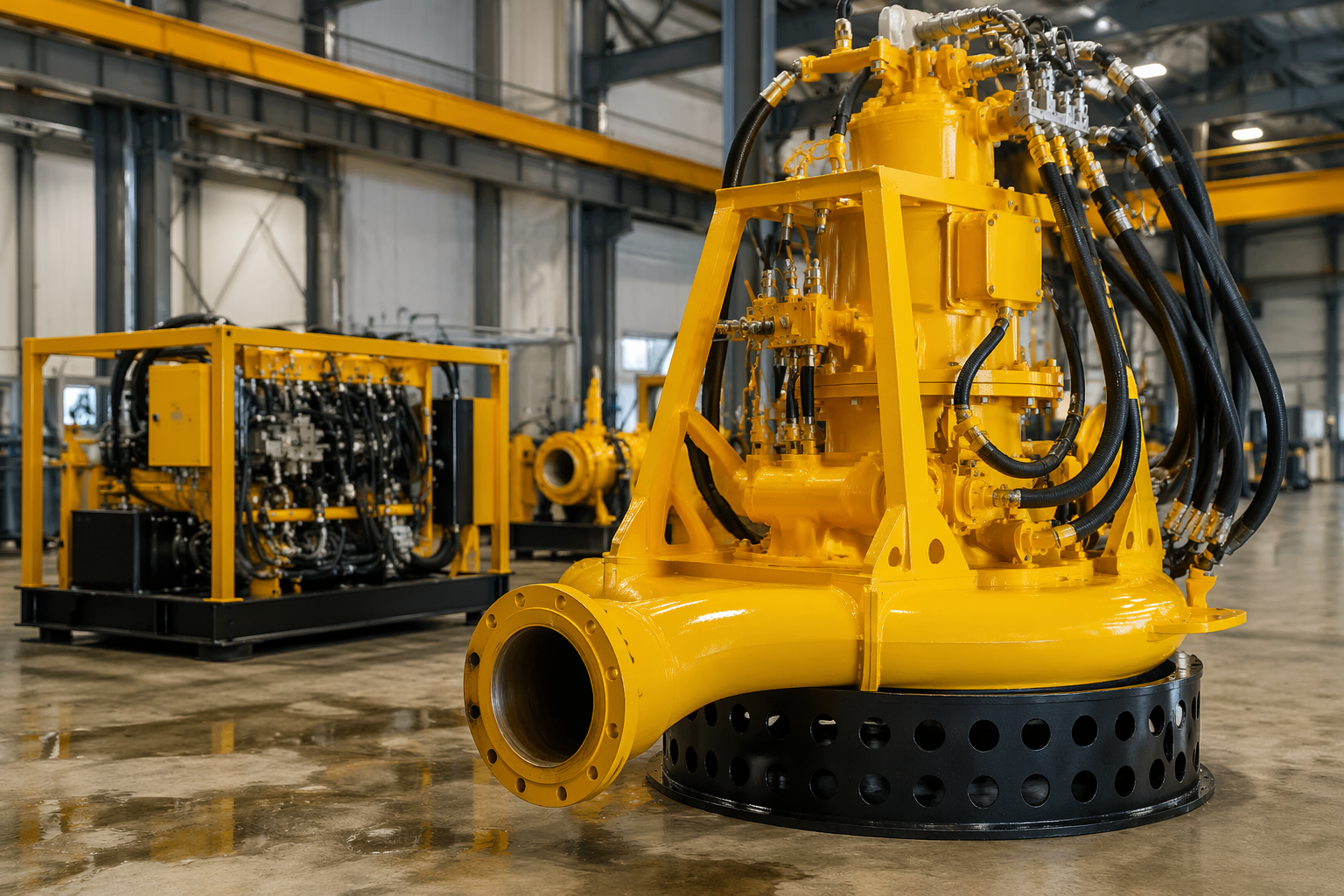
At its core, a hydraulic dredge pump is a heavy-duty pump assembly driven by a hydraulic motor rather than an onboard electric motor or diesel engine directly coupled at the pump body. The hydraulic power unit supplies pressurized fluid through hoses to the motor, which then drives the impeller. This configuration gives engineers more freedom in deployment because the power source can remain on a barge, excavator, skid, crane platform, or shoreline package while the pump itself operates underwater or at the slurry face.
According to NFPA fluid power industry guidance, hydraulic power remains a preferred solution in applications requiring high power density and controllable force in compact spaces. In dredging, that compact power density translates into practical benefits: easier mounting on excavator arms, stable output in submerged conditions, and better adaptability to modular frames, cutter heads, jetting rings, or agitators.
As Eric Lanke, President and CEO of the National Fluid Power Association, states: “Fluid power technologies provide unmatched power density and controllability for demanding mobile and industrial applications.” That statement aligns directly with dredging reality. When operators need to move dense slurry mixtures through varying pipe lengths and elevations, consistent torque and speed control matter.
Typical system discussions should include PSI and GPM. A hydraulic dredge pump may run on a power unit delivering several thousand PSI and flow rates matched to the motor size, while the dredging side must also be evaluated in slurry flow terms such as discharge capacity, solids concentration, and total dynamic head. Buyers should not confuse hydraulic oil flow with slurry flow. The hydraulic circuit powers the motor; the pump hydraulics then determine how much mud, sand, or sediment is moved.
According to SAE International, hydraulic system design best practice emphasizes proper control of pressure, flow, contamination, and temperature to ensure dependable performance. That is vital in dredging because abrasive service already stresses the wet end. If the hydraulic loop is poorly designed, excess heat, unstable pressure, or contamination can shorten motor and valve life.
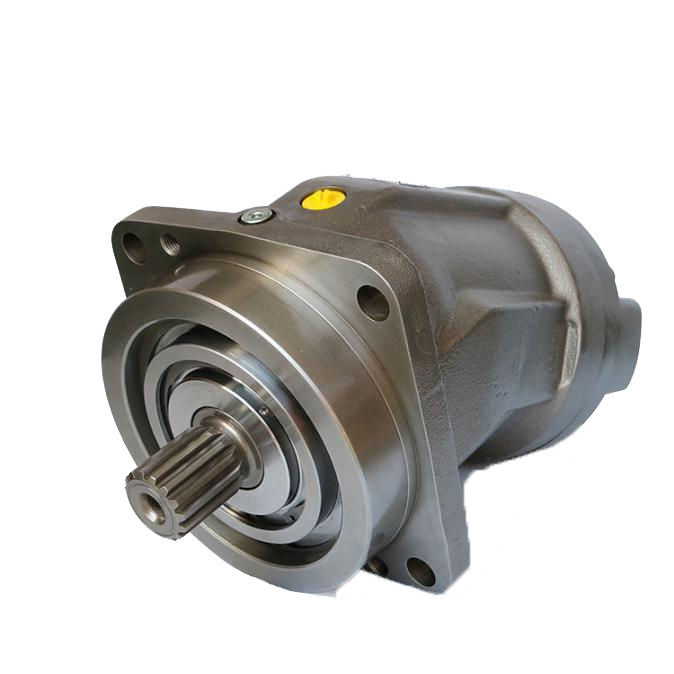
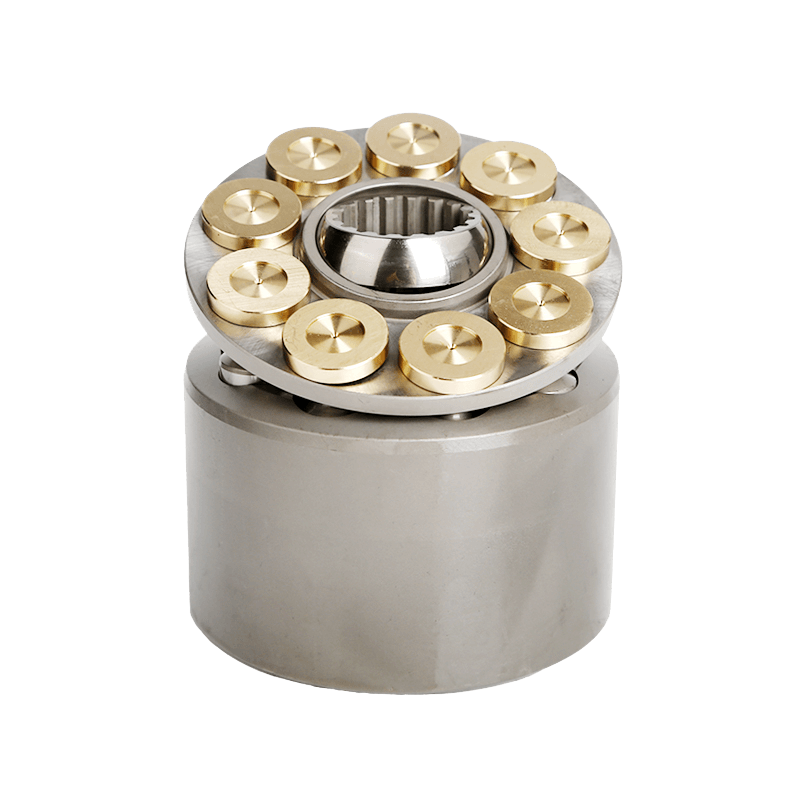
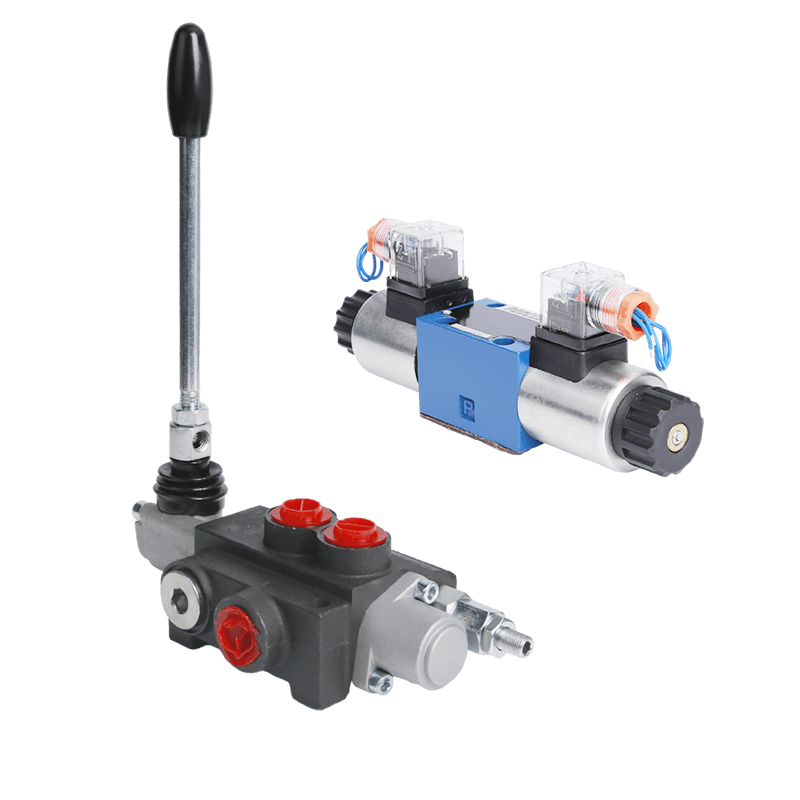
The major technical components often include hydraulic pumps, control valves, hydraulic motors, cylinders for related boom or positioning systems, and the dredge pump wet end itself. In excavator dredging packages, hydraulic cylinders control arm positioning, while pumps, valves, and motors coordinate tool motion and slurry pumping. A complete solution therefore involves more than just the pump casing and impeller.
According to IBISWorld, equipment buyers in industrial sectors increasingly prioritize durability, uptime, and aftermarket support over lowest upfront cost alone. This helps explain demand for wear-resistant impellers, hardened liners, large solids passages, and optional agitators designed to suspend settled material before pumping. For high-solids sand applications, submersible placement is a major advantage because the pump works closer to the deposit, often improving slurry concentration versus long suction-lift arrangements.
As a technical benchmark, many buyers evaluate whether the pump can handle abrasive sand, silt, gravel, and sludge without frequent clogging; whether it can be integrated into a portable or remote operated frame; and whether it supports excavator deployment for hydraulic dredge pump excavator applications. POOCCA can support these requirements with configurable hydraulic components and project-oriented manufacturing support for OEMs and system integrators.
As one marine equipment engineering manager commonly notes in dredging projects, “The best pump is not the one with the biggest brochure number; it is the one that maintains solids production without constant intervention.” That practical view is critical. Real productivity depends on stable slurry concentration, wear resistance, motor matching, and maintainability—not just headline capacity.
According to Grand View Research, automation and energy-efficiency trends continue to influence industrial equipment purchasing decisions. This supports growing interest in variable control strategies, remote monitoring, and optimized hydraulic packages that can reduce fuel waste while maintaining target throughput. For project managers comparing a Subdredge-style concept, a compact Mudflo® package, or a portable Multiflo®-type deployment approach, the decision should rest on application fit, not branding alone.
3. Industry Standards and Compliance: What Serious Buyers Should Verify
In B2B dredging procurement, certifications and standards are more than checkboxes. They provide evidence that a supplier understands traceability, process control, safety expectations, and repeatable quality. The first benchmark many buyers look for is ISO 9001. ISO 9001 does not guarantee that every hydraulic dredge pump is superior, but it does indicate the manufacturer follows a documented quality management system covering process consistency, corrective action, and customer-focused improvement.
According to ISO, ISO 9001 remains the world’s most widely recognized quality management standard, used by organizations in over 170 countries. For purchasers of hydraulic pumps, motors, valves, and integrated dredging systems, that matters because repeatability in machining, testing, assembly, and documentation directly affects field performance.
Another important mark for many international markets is CE marking. Where applicable, CE marking signals conformity with relevant European requirements for safety, health, and environmental protection. For hydraulic systems, this often intersects with machinery safety, pressure-related considerations, documentation, and risk assessment. Buyers exporting or operating across different regions should clarify what level of CE compliance applies to the full dredging package versus individual components.
SAE International standards are also highly relevant in hydraulic system design, especially when discussing hose specifications, fittings, pressure ratings, cleanliness, and fluid power integration. In mobile dredging units mounted on excavators or cranes, adherence to sound SAE-aligned engineering practice can reduce leakage risk, improve serviceability, and support safer operation under high-pressure duty cycles.
NFPA guidance is valuable when evaluating hydraulic power units, fluid cleanliness, system efficiency, and fluid power component selection. Dredging is one of those sectors where contamination control is frequently underestimated. A premium wet-end design can still fail prematurely if hydraulic oil cleanliness, sealing, and cooling are neglected.
For buyers in oil, gas, or adjacent heavy industries, references to API standards may also be relevant. While many dredge pumps are not directly API pumps in the strictest sense, API-aligned quality culture around materials, pressure integrity, testing rigor, and documentation can still influence supplier selection, especially for engineered packages serving industrial slurry environments.
As Alison Schumacher, former technical standards leader within fluid power industry circles, has emphasized: “Standards help create a common language for performance, safety, and reliability.” That is exactly why serious dredging contractors ask for more than a datasheet. They ask about pressure ratings, material specifications, test procedures, tolerances, documentation packages, and quality records.
When evaluating a supplier, request evidence of manufacturing controls for hydraulic pumps, motors, valves, manifolds, and cylinders—not just marketing claims. POOCCA is relevant here because it connects quality-driven production with custom solutions and factory-direct supply support, which is valuable for OEMs building portable dredge skids, excavator attachments, or remote-operated slurry pumping systems.
4. Implementation Guide: Selecting and Deploying the Right Hydraulic Dredge Pump
Implementation starts with the material, not the pump catalog. Ask five core questions: What is the solids type? What particle size range is expected? What slurry concentration is realistic? What discharge distance and elevation are required? And what carrier platform will be used? These determine whether the best answer is a compact submersible unit, a larger hydraulic dredge pump for excavator mounting, or a portable barge-mounted package.
According to MarketsandMarkets, end users increasingly favor integrated equipment solutions that reduce commissioning time and simplify maintenance planning. In dredging terms, this means buyers often prefer a matched package: hydraulic power unit, hoses, control valves, submersible pump, mounting frame, and optional agitator or cutter interface. A pieced-together system may look cheaper initially, but mismatched hydraulic flow, pressure, and cooling capacity can create expensive field problems.
A practical implementation example is shallow lagoon or pond dredging. A small hydraulic dredge pump can be mounted to an excavator boom so the operator can reach compacted sediment, agitate it, and pump it without building a major civil setup. This approach is often chosen when mobility matters more than continuous mega-capacity output. In another example, a remote operated pump can be deployed from a pontoon in areas with unsafe bank access or variable water depth.
Success depends on proper sizing. If the hydraulic motor is oversized for available flow, performance suffers. If undersized, the pump may stall under dense slurry. The same logic applies to discharge pipeline diameter. A pump able to move high solids at the source can still underperform if the pipeline induces excessive friction loss. This is why total system review is essential.
According to Statista, infrastructure and marine construction investment remains strong in many regions, increasing demand for portable and rapidly deployable slurry-handling equipment. Contractors that standardize on adaptable hydraulic packages often gain scheduling advantages because they can move equipment between sites faster and reconfigure for sand recovery, sludge removal, canal cleaning, or barge unloading.
For buyers comparing options under searches like “hydraulic dredge pump for sale,” “used hydraulic dredge pump,” or “best hydraulic dredge pump,” the right process is to compare lifecycle variables: wear parts cost, lead time, support availability, hydraulic compatibility, and expected solids throughput. New equipment with stronger engineering support may deliver a lower total cost than a used pump with unknown wear history and no documentation.
POOCCA can add value in this phase by supporting custom hydraulic matching, OEM-oriented supply, and flexible MOQ arrangements for customers building standardized dredging attachments or specialized project packages. That combination is especially useful when a buyer needs a hydraulic solution tailored to a narrow excavator class, power pack envelope, or target PSI/GPM operating window.
5. Future Outlook: Smarter, More Modular Hydraulic Dredging Solutions
The outlook for hydraulic dredge pumps is positive because market demand is aligning with their strengths: mobility, modularity, solids handling, and compatibility with modern hydraulic control systems. According to Grand View Research, industrial equipment buyers are increasingly prioritizing efficiency, monitoring capability, and reduced downtime. In dredging, this points toward more sensor-enabled hydraulic systems, better wear monitoring, improved control valves, and modular pump packages that can be adapted for multiple jobs.
Future product development will likely emphasize easier maintenance access, smarter remote diagnostics, stronger wear materials, and better integration with excavators, amphibious carriers, and autonomous or semi-remote dredging platforms. For contractors working in sand, mining tailings, environmental remediation, and harbor maintenance, that means the next generation of submersible and portable hydraulic dredge pumps should become even more application-specific and productive.
At the same time, buyers will continue to expect compliance alignment, documented quality systems, and responsive supply chains. Manufacturers that can combine technical credibility with flexible commercial support will be best positioned to win. If your project requires a custom hydraulic dredge pump solution, OEM component support, or factory-direct guidance on pumps, motors, valves, and related hydraulic systems, connecting with POOCCA is a practical next step.
Frequently Asked Questions
What should I know before buying a used submersible dredge pump with hydraulic system?
Buying used can reduce upfront cost, but it also raises risk. According to IBISWorld, industrial buyers increasingly prioritize uptime and support because unplanned downtime can erase apparent savings very quickly. For a used hydraulic dredge pump, inspect impeller wear, liner condition, motor leakage, bearing play, hose integrity, manifold condition, and maintenance records. Ask for original PSI and GPM requirements, prior slurry type, total operating hours, and whether the unit was used in sand, mud, tailings, or corrosive media. Also verify whether spare parts are still available. If the pump lacks documentation, hydraulic matching becomes harder and the system may underperform when connected to your excavator or power pack. A used unit can work well for short-term projects if it comes from a credible source with test results, but for buyers needing predictable production and warranty-backed support, a new or factory-refurbished package is often safer.
Where can I find a submersible dredge pump with hydraulic system PDF or technical datasheet?
A proper PDF or datasheet should include flow curve data, solids handling limits, hydraulic motor requirements, pressure range, flow demand, material construction, maximum particle size, weight, and recommended installation layouts. According to ISO, documented process and product information is fundamental to quality communication between supplier and buyer. That means a credible manufacturer should be able to provide more than just a brochure headline. Look for details on discharge size, wear material options, seal arrangement, CE-related documentation where relevant, and maintenance intervals. If you are comparing portable, remote operated, or excavator-mounted models, the PDF should also state mounting options and compatible power unit ranges. A complete technical package often includes dimensional drawings, exploded views, and hydraulic schematics. If you are sourcing for OEM or project integration, asking the supplier for performance curves and installation guidance is more valuable than relying on generic catalog claims.
What determines submersible dredge pump with hydraulic system price?
Price depends on more than pump size. Key cost drivers include hydraulic motor capacity, wear-resistant material selection, solids handling capability, agitator or cutter options, frame design, hose package, control valves, and whether the system is sold as a full turnkey package. According to MarketsandMarkets, buyers are placing more value on integrated systems that reduce commissioning complexity, which means complete packages often command a higher price but lower implementation risk. A small hydraulic dredge pump for pond sludge can be far less expensive than a heavy-duty submersible sand pump designed for excavator deployment and abrasive slurry. Customization also affects cost. If you need specific PSI/GPM matching, CE-related documentation, or OEM branding, pricing will increase accordingly. Buyers should compare total lifecycle cost rather than only purchase price, including wear parts, service access, delivery lead time, and expected production rate.
How do I evaluate submersible dredge pump with hydraulic system manufacturers?
Start with technical capability, then validate manufacturing discipline. According to ISO, quality management systems help organizations deliver consistent outputs and customer satisfaction; in practice, that means ISO 9001 alignment is a useful signal when screening manufacturers. Next, review whether the supplier can provide hydraulic pumps, motors, valves, and related components as a coherent package rather than a loose collection of parts. Ask for test procedures, material certificates, case studies, and references in dredging, mining, or slurry transfer. Manufacturers serving OEMs should also offer customization, documentation, and stable supply. For international projects, ask about CE marking where applicable and whether designs follow sound SAE and NFPA engineering practices. Finally, evaluate commercial fit: can the supplier support factory-direct pricing, flexible MOQ, and after-sales communication? These factors often matter as much as headline capacity when the equipment is deployed in harsh marine or sediment-heavy conditions.
What is the best hydraulic dredge pump for excavator applications?
The best unit is the one matched to your carrier and material profile. An excavator-mounted hydraulic dredge pump needs correct hydraulic flow, pressure compatibility, structural mounting integrity, and enough solids handling capacity for the target sediment. According to SAE International, proper hydraulic system design depends on controlling pressure, flow, temperature, and cleanliness—four variables that strongly influence excavator dredging performance. If the excavator cannot provide sufficient GPM at the required PSI, even a premium pump will fail to deliver expected throughput. For compact canal cleaning or lagoon maintenance, a smaller submersible unit may be ideal. For sand recovery or denser sediment, you may need a heavier-duty pump with agitator assistance and stronger wear parts. Also consider boom reach, discharge line routing, and whether the operation needs portable support equipment or remote control features. The best choice is rarely the largest one; it is the one engineered for your excavator’s hydraulic envelope and your slurry conditions.
Is a small hydraulic dredge pump a good option for sand, mud, and portable dredging jobs?
Yes, in many cases a small hydraulic dredge pump is the most efficient choice for localized or mobile work. According to Statista, sustained investment in construction and marine maintenance continues to create demand for flexible, jobsite-ready equipment rather than only large fixed systems. A compact pump can be ideal for farm ponds, settlement basins, marinas, narrow canals, geotextile tube feeding, and small barge cleanout tasks. The main advantages are mobility, fast setup, and easier integration with excavators or skid-mounted hydraulic power packs. However, buyers must still verify solids concentration, particle size, and discharge distance. A small pump can outperform a larger unit in short-run applications if it is properly matched to the slurry and line losses. For sand-heavy work, wear material and agitator effectiveness become especially important. In short, small portable systems are excellent when access is limited, jobs change frequently, or rapid mobilization matters more than maximum continuous tonnage.