 English
 Russian
 Arabic
 Indonesian
 Turkish
 Vietnamese
 Polish
 German
 Malay
Malay Thai
Thai Kazakh
 Spanish
 Chinese (Simplified)
 Korean
 Italian
 Azerbaijani
 Dutch
Dutch French
 Romanian
 Portuguese
 Hindi
HindiAccording to Grand View Research, the global hydraulic equipment market was valued at more than USD 45 billion in recent years, underscoring the continuing demand for compact, reliable fluid power systems across construction, agriculture, material handling, and mobile equipment. For buyers sourcing a 12 volt hydraulic pump and reservoir, the market opportunity is clear: compact electric hydraulic power units are increasingly preferred where DC power, portability, and controlled lifting or dumping performance matter most. Whether you need a 12 Volt Hydraulic Pump Single Acting setup for a dump trailer or a 12 Volt Hydraulic Power Unit Double Acting design for bidirectional cylinder control, selecting the right package requires understanding pressure, flow, duty cycle, reservoir size, and compliance standards.
This guide goes beyond basic product listings by explaining how Volt-powered Hydraulic Power systems work, what technical specifications actually matter, and how procurement teams can compare Electric compact units for lifting, tipping, and mobile actuation. It also highlights how manufacturers such as POOCCA support OEMs and distributors with custom solutions, factory-direct pricing, flexible MOQ, and quality systems aligned with ISO 9001.
Market Demand for 12 Volt Hydraulic Power Units in Mobile Equipment
The appeal of a 12 volt hydraulic pump and reservoir starts with mobility. Unlike larger AC-driven hydraulic stations, 12V DC systems can be powered directly from batteries installed on trailers, service trucks, utility vehicles, agricultural attachments, and marine applications. This makes them especially useful for intermittent-duty tasks such as raising a dump bed, operating a liftgate, actuating a snowplow, or powering a compact press.
According to Markets and Markets, the fluid power equipment market is projected to grow at a steady CAGR through the end of the decade, driven by industrial automation, mobile machinery, and equipment modernization. That matters because compact hydraulic Units are part of this shift: buyers increasingly want smaller, more efficient systems that still deliver 2,000 to 3,500 PSI and practical flow ranges such as 0.5 to 3.0 GPM for mobile applications.
According to Statista, global construction machinery and agricultural equipment demand continues to support component-level growth in hydraulic cylinders, hydraulic pumps, valves, and motors. For many OEMs, this translates into stronger demand for Compact DC power packs that are easier to integrate into space-constrained equipment.
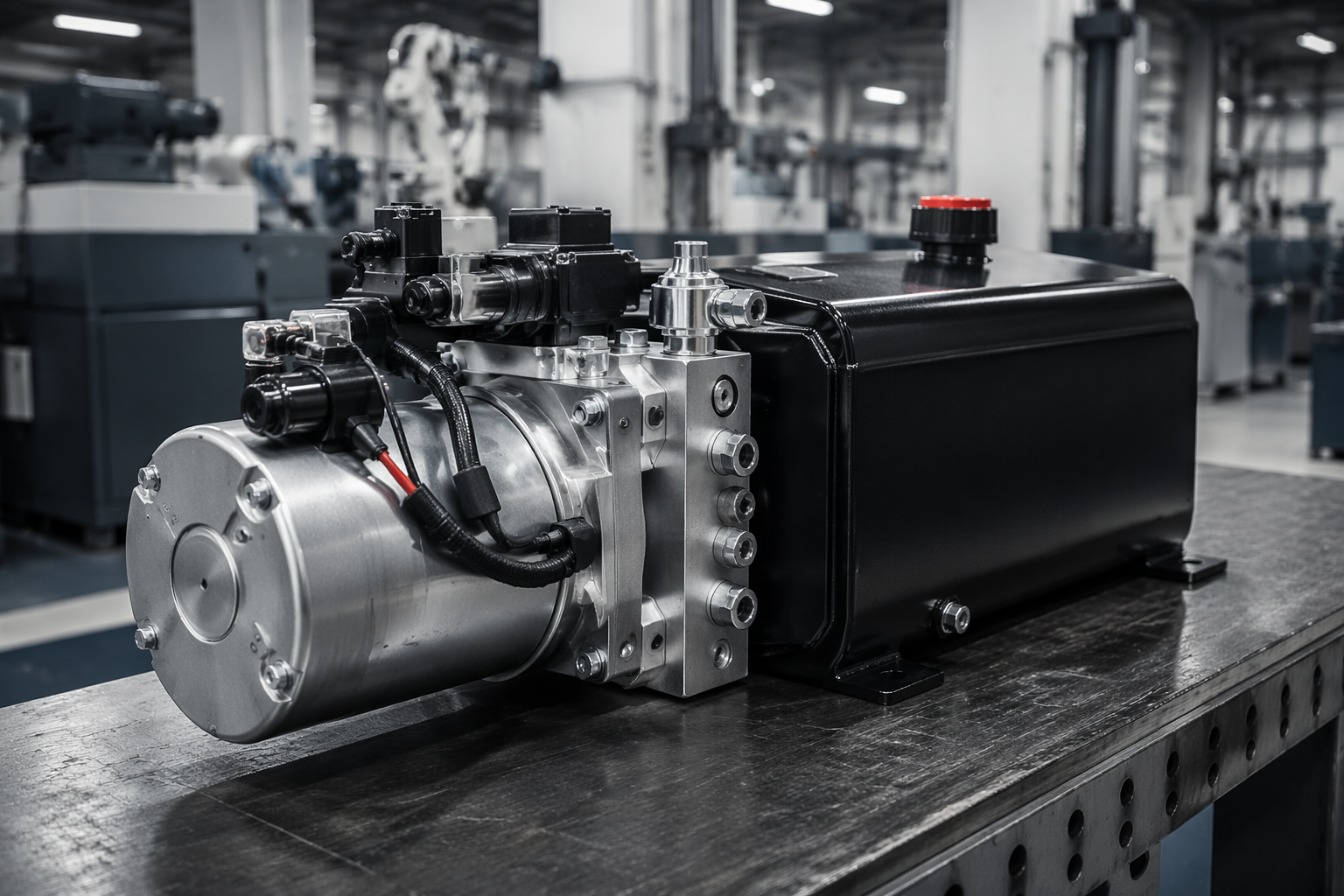
A typical 12V hydraulic system combines an electric motor, hydraulic pump, reservoir, manifold, valves, wiring harness, and relief protection in one assembly. In practical terms, this integrated design reduces installation complexity compared with building a hydraulic circuit from separate components. It also supports faster field replacement for maintenance teams.
From a procurement perspective, buyers are now comparing more than just price. They also evaluate tank material, corrosion resistance, duty cycle, port sizing, remote control options, mounting orientation, and support for single-acting or Double acting cylinders. This is where supplier capability becomes a differentiator. POOCCA can support customized hydraulic power unit configurations with flexible MOQ for distributors, OEMs, and aftermarket customers who need application-specific voltage, tank, valve, and manifold options.
According to IBISWorld, industrial equipment buyers are placing greater emphasis on lifecycle value rather than upfront purchase cost alone. In the case of a 12 volt hydraulic pump and reservoir, that means reliability, seal life, pressure consistency, and sourcing confidence can outweigh minimal differences in initial unit price.
Technical Deep Dive: How a 12 Volt Hydraulic Pump and Reservoir Works
A 12 volt hydraulic pump and reservoir is essentially a compact Electric hydraulic power source. When the DC motor is energized, it drives a hydraulic pump—often a gear pump—which draws oil from the reservoir and forces it into the circuit. The pressurized fluid then moves through valves to actuate hydraulic cylinders or motors. System force depends on pressure and cylinder area, while speed depends on flow in GPM.
In mobile equipment, common operating pressures range from 2,500 PSI to 3,200 PSI, with some heavy-duty designs reaching 3,500 PSI. Common reservoir capacities include 2, 4, 6, 8, 10, and 12 quarts depending on cylinder volume and duty requirements. For a dump trailer, a single-acting unit may only power cylinder extension while gravity handles retraction. By contrast, a 12V Hydraulic Pump Double Acting system powers both extension and retraction, making it suitable for applications where controlled return motion is essential.
According to NFPA fluid power guidance, proper system design depends on matching flow, pressure, actuator volume, and duty cycle rather than simply choosing the highest horsepower motor available. Oversizing can increase battery draw, heat generation, and unnecessary cost. Undersizing can produce slow cycle times, poor responsiveness, and premature component wear.
As Robert Koski, former NFPA President and CEO, states: “Fluid power systems deliver their best performance when design decisions are made around the full application profile, not just peak pressure.” That principle is especially important for compact DC hydraulic power packs, where electrical constraints and thermal limits are significant.
Here are the main technical variables buyers should evaluate:
1. Pressure rating: Pressure, measured in PSI, determines how much force the system can generate. A unit designed for 3,000 PSI can typically handle more demanding lifting tasks than a 2,000 PSI version, assuming the cylinder and plumbing are also rated appropriately.
2. Flow rate: Flow, measured in GPM, affects speed. A 1.5 GPM unit may be sufficient for occasional lifting, while faster dump cycles may require 2.0 to 3.0 GPM depending on cylinder displacement and battery capacity.
3. Single-acting vs. double-acting: Single Acting units are simpler and often lower cost, commonly used on dump trailers. Double Acting units are preferred for controlled bidirectional movement in lifts, compact machinery, and specialty mobile equipment.
4. Reservoir sizing: The reservoir must hold enough fluid to support cylinder extension and thermal stability. A tank that is too small can increase foaming, oil heating, and inconsistent performance.
5. Motor power and duty cycle: A 12V DC motor must align with expected run times. Intermittent-duty applications are common, but repeated cycles may require upgraded wiring, relays, and cooling considerations.
According to SAE International technical publications, hydraulic system efficiency depends heavily on minimizing pressure loss across hoses, fittings, valves, and manifolds. Even a well-rated unit can underperform if the circuit includes undersized ports or restrictive valves. This is why experienced buyers look beyond catalog PSI and compare overall circuit design.
As Erik Björklund, a fluid power engineering specialist cited in industry training materials, states: “The pump, valve, and cylinder must be sized as a system. A strong motor alone cannot compensate for poor hydraulic matching.” For buyers evaluating a Heavy duty 12 volt hydraulic Pump or a 12V Hydraulic Pump and cylinder package, this systems approach is critical.
Manufacturers like POOCCA can help buyers configure hydraulic pumps, valves, cylinders, and integrated power packs for real-world load and duty requirements instead of forcing one-size-fits-all catalog choices.
Industry Standards, Compliance, and What Buyers Should Verify
Compliance matters in hydraulic procurement, especially for OEM export projects, replacement parts for regulated industries, and distributor sourcing programs. A quality 12 volt hydraulic pump and reservoir should not only meet the application’s performance requirements but also align with recognized manufacturing and documentation standards.
The most important baseline is ISO 9001. This standard does not certify a hydraulic power unit’s technical performance by itself, but it does indicate that the manufacturer operates a documented quality management system covering traceability, process consistency, corrective action, and customer feedback loops. For buyers comparing factories, ISO 9001 is often a first-pass credibility screen.
Where applicable, buyers should also ask about CE marking for products entering European markets. CE requirements depend on the product category, control method, and end-use environment, but documentation readiness is an important sign of supplier maturity. In specialized energy or industrial sectors, API standards may also influence component expectations, especially when hydraulic systems are integrated into broader equipment packages.
From a technical design standpoint, SAE International standards are highly relevant for ports, threads, hose ends, and mobile hydraulic practices. Thread mismatch remains a common source of leakage and field installation failure. If your unit uses SAE ports but your equipment is built around metric or BSP interfaces, installation delays and contamination risks increase quickly.
NFPA guidance is also useful for fluid power symbols, system design best practices, safety considerations, and application engineering. In North American markets, buyers frequently expect familiarity with NFPA terminology and hydraulic schematic conventions.
According to ISO, standardized quality and process control reduce variation and improve supplier consistency across repeat orders. For buyers placing larger OEM or distributor programs, that consistency is essential. Reordering a hydraulic power unit six months later should not introduce avoidable differences in manifold machining, relief valve settings, or wiring layout.
According to SAE International, connection integrity and compatibility are among the most overlooked contributors to hydraulic system downtime. That is particularly important for 12 volt hydraulic pump and reservoir kit buyers, because compact kits are often installed quickly in the field, where an incorrect fitting can compromise the whole circuit.
For sourcing teams, the practical checklist should include: pressure test records, motor specifications, relief valve setting range, tank cleanliness, wiring diagram, mounting dimensions, port standard, seal material, and support documentation. POOCCA positions itself well for these requirements by combining custom solutions with factory-direct pricing and flexible MOQ, which is valuable for both pilot orders and scaled procurement. Buyers can discuss application-specific needs directly through POOCCA.
How to Choose the Right 12 Volt Hydraulic Pump and Reservoir for Your Application
Choosing the right unit starts with the load and the actuator. If the application uses a hydraulic cylinder, calculate the required force first. Force equals pressure multiplied by effective piston area. Then estimate desired extension or retraction speed to determine GPM requirements. Finally, confirm battery capacity, cable sizing, duty cycle, and reservoir volume.
For example, a dump trailer using a single-acting telescopic cylinder may prioritize high pressure with moderate flow and a reservoir large enough to support full extension. A service body liftgate may need smoother control, faster cycling, and compact packaging. A wheelchair lift or small materials platform may require a 12 volt hydraulic pump with Wireless Remote option for operator convenience and safety.
According to Markets and Markets, end users increasingly favor compact and modular fluid power systems that reduce installation labor and support easier servicing. This trend helps explain the popularity of integrated power units versus assembling separate motors, pumps, brackets, and tanks from multiple vendors.
Success in the field usually depends on good matching, not maximum rating. Buyers looking for the Best 12 volt hydraulic power units should compare these factors:
Application type: Dump trailer, liftgate, snowplow, material platform, scissor lift, utility truck, agricultural implement, marine hatch, or industrial fixture.
Acting type: 12 Volt Hydraulic Pump Single Acting for gravity return; 12 Volt Hydraulic Power Unit Double Acting for powered extension and retraction.
Reservoir material: Steel reservoirs offer durability, while plastic tanks can reduce weight and resist corrosion in some conditions.
Mounting space: Measure envelope dimensions carefully. In compact equipment, manifold orientation and motor clearance matter as much as pressure rating.
Electrical setup: Verify starter solenoid, remote pendant, battery cable gauge, fuse protection, and remote-control integration.
Maintenance access: Ensure easy access to filler breather, drain, relief setting, and valve troubleshooting points.
According to Statista, industrial buyers continue to prioritize reliability and availability in replacement component purchases, especially where equipment downtime directly affects revenue. In practical terms, this means sourcing from a manufacturer that can support repeatability, spare parts, and engineering communication is often smarter than selecting the cheapest anonymous unit online.
A well-specified 12 volt hydraulic pump and reservoir can deliver years of dependable service if oil cleanliness, correct voltage supply, and proper relief settings are maintained. That is why many OEM and distributor buyers prefer working with manufacturers that can customize tanks, manifold layouts, valve logic, and branding while still maintaining controlled quality systems.
Future Outlook for Compact Electric Hydraulic Power Units
The outlook for compact DC hydraulic Power packs remains strong. Growth in mobile work equipment, trailer electrification, compact utility vehicles, and aftermarket replacement demand all support continued investment in 12V and 24V hydraulic systems. While electrification is changing many machine architectures, hydraulics remain highly effective wherever high force density and rugged outdoor operation are required.
According to Grand View Research, demand for efficient and application-specific hydraulic solutions is expected to stay resilient as industries modernize equipment and seek better performance per installed footprint. For buyers, this means the market will likely offer more modular, smarter, and easier-to-integrate Hydraulics Pumps and power pack solutions in the coming years.
We can also expect improvements in remote control interfaces, corrosion-resistant reservoir options, cartridge valve integration, and lower-noise motor designs. For OEMs, branded compact units with configurable manifolds and flexible tank capacities will become increasingly attractive.
If your business is evaluating a 12 volt hydraulic pump and reservoir for dump trailers, lifts, compact machinery, or custom mobile equipment, now is a practical time to standardize your specification strategy. Working with an experienced supplier such as POOCCA can help reduce sourcing risk while giving you access to custom configurations, ISO 9001-aligned manufacturing, and scalable supply support through direct consultation.
Frequently Asked Questions
How much weight can a 12V hydraulic pump lift?
A 12V hydraulic pump does not lift a fixed amount of weight by itself; lifting capacity depends on system pressure, cylinder bore, mechanical geometry, and load distribution. For example, a system running at 3,000 PSI with a 2-inch bore cylinder generates roughly 9,400 pounds of theoretical force before accounting for friction and mechanical losses. A larger 3-inch bore cylinder at the same pressure can generate more than 21,000 pounds of force. According to NFPA guidance, force calculation should always be based on pressure multiplied by effective piston area rather than motor size alone. This is why a compact 12 volt hydraulic pump and reservoir can still power substantial lifting tasks in dump trailers, lifts, and utility equipment. However, the real-world answer also depends on whether the setup is single-acting or double-acting, the stroke length, and whether leverage reduces effective lifting force. According to SAE International, poor hose sizing and pressure losses can materially reduce available actuator force in mobile hydraulic systems. Buyers should therefore size the complete hydraulic circuit, not just the pump label. If you are pairing a 12V Hydraulic Pump and cylinder, confirm PSI rating, GPM, relief valve setting, and cylinder dimensions together for an accurate lifting estimate.
How to size a hydraulic power unit?
To size a hydraulic power unit, start with four variables: required force, cylinder or motor speed, duty cycle, and available electrical input. First calculate force from the load and application geometry. Then choose the pressure level needed in PSI. Next, calculate fluid volume needed to move the cylinder through its stroke and determine the flow rate in GPM needed for your target cycle time. Reservoir size must also support actuator volume and allow reasonable thermal performance. According to NFPA fluid power design principles, proper sizing depends on the full operating profile, including starts per hour, ambient temperature, and expected load variation. For a 12 volt hydraulic pump and reservoir, battery draw and cable sizing are especially important because low voltage under load can reduce motor performance. According to Markets and Markets, compact modular power packs are gaining preference partly because they simplify this sizing process for OEMs and maintenance teams. If you need a 12 Volt Hydraulic Pump Single Acting for a dump trailer, prioritize cylinder volume, lift time, and tank capacity. If you need a 12 Volt Hydraulic Power Unit Double Acting, also calculate retraction flow and return-side control requirements. A supplier such as POOCCA can help match pumps, valves, cylinders, and reservoirs to your actual duty conditions.
How long do hydraulic power units last?
A well-maintained hydraulic power unit can last 5 to 10 years or longer, though actual life varies by duty cycle, oil cleanliness, pressure spikes, environment, and installation quality. Intermittent-duty 12V systems used on dump trailers or liftgates often last many years if operators avoid excessive continuous running and maintain proper oil levels. According to ISO quality management principles, consistent manufacturing and process control can improve repeatability and reduce premature failure risk across seals, manifolds, and motor assemblies. In practice, the major life-limiting factors are contamination, overheating, low battery voltage, water ingress, and relief valve misuse. According to SAE International, hydraulic connection integrity and contamination control are among the most common contributors to reduced system life in mobile equipment. That means the lifespan of a 12 volt hydraulic pump and reservoir depends as much on installation discipline as on factory build quality. Buyers should inspect filters or breathers, verify port compatibility, use the correct hydraulic fluid, and check for voltage drop during operation. A heavy duty 12 volt hydraulic Pump used within its rated PSI and GPM range will generally outlast an oversized or poorly installed unit that is constantly overloaded.
What is the difference between a hydraulic power pack and a hydraulic power unit?
In most commercial usage, the terms “hydraulic power pack” and “hydraulic power unit” are closely related and often interchangeable. Both refer to an assembly that includes a motor, hydraulic pump, reservoir, valves, and associated controls used to generate and direct hydraulic energy. The term “power pack” is often used for smaller, more portable, or application-specific assemblies, while “power unit” may be used more broadly across industrial and mobile systems. For buyers searching for a 12 volt hydraulic pump and reservoir kit, either label may describe the same type of product. According to IBISWorld, industrial equipment purchasing increasingly favors integrated modular assemblies because they simplify sourcing, installation, and maintenance. In practical terms, what matters more than the name is the configuration: single-acting versus double-acting, operating PSI, flow in GPM, reservoir capacity, and electrical control options. According to Statista, industrial replacement purchasing is strongly influenced by compatibility and uptime requirements, which is why exact technical matching is more important than terminology. If you are replacing an existing compact DC system, verify manifold layout, valve function, tank size, mounting dimensions, and motor rotation rather than assuming any “power pack” will fit. For OEMs, manufacturers like POOCCA can adapt the unit labeling and configuration to market or application requirements.
What should buyers look for in the best 12 volt hydraulic power units?
The best 12 volt hydraulic power units combine correct application sizing with strong build quality, stable supply, and technical support. Start with performance basics: operating pressure in the 2,500 to 3,500 PSI range for many mobile applications, suitable flow in GPM, and enough reservoir capacity to support full actuator travel. Then evaluate the quality of hydraulic pumps, valves, motors, wiring, seals, and tank construction. According to Grand View Research, demand for application-specific and efficient hydraulic solutions continues to rise as end users seek better performance and reliability from compact systems. That means generic low-cost units may not deliver the best lifecycle value. Buyers should also assess whether the supplier supports ISO 9001 processes, CE marking where needed, clear wiring diagrams, relief valve specifications, and spare parts access. For a 12 volt hydraulic pump with Wireless Remote, also verify remote range, sealing protection, and fail-safe function. According to NFPA principles, overall system matching remains the most important determinant of performance. A well-matched single-acting unit for a dump trailer may outperform an overcomplicated double-acting package in the wrong application. The “best” unit is therefore the one that fits your load, cylinder volume, duty cycle, and installation space while maintaining dependable quality and support.
Should I choose a 12 Volt Hydraulic Pump Single Acting or Double Acting?
The choice between single-acting and double-acting depends on how the actuator needs to move. A 12 Volt Hydraulic Pump Single Acting system pressurizes the cylinder in one direction only, and the return movement usually occurs by gravity or an external load. This makes it common for dump trailers and simple lifting platforms. A 12 Volt Hydraulic Power Unit Double Acting system applies pressure in both directions, giving controlled extension and retraction. That is often better for lifts, compact machinery, and equipment where downward or reverse motion must be powered rather than passive. According to SAE International mobile hydraulic design references, system architecture should follow the application’s control and safety requirements rather than defaulting to the simplest circuit. Single-acting systems are often more economical, require fewer hydraulic lines, and may be easier to service. Double-acting systems offer more precise motion control and are better suited when the load does not reliably return on its own. According to Markets and Markets, demand for compact modular hydraulic systems is growing partly because users increasingly want application-specific functionality without overbuilding the system. If you are uncertain, compare the required load control, hose routing, reservoir sizing, and operator expectations before selecting the circuit type.