 English
 Russian
 Arabic
 Indonesian
 Turkish
 Vietnamese
 Polish
 German
 Malay
Malay Thai
Thai Kazakh
 Spanish
 Chinese (Simplified)
 Korean
 Italian
 Azerbaijani
 Dutch
Dutch French
 Romanian
 Portuguese
 Hindi
HindiAccording to Grand View Research, the global hydraulic equipment market was valued at more than USD 45 billion in recent years, reflecting how critical hydraulic cylinders, pumps, valves, and motors remain across construction, MRO, mining, utilities, transport, and water handling applications. For buyers searching for a battery hydraulic pump, the market is shifting quickly toward portable, high pressure, cordless systems that reduce setup time, improve operator mobility, and support safer field service. Whether you are a newbie here considering 12/24/48/60V options, evaluating a battery powered hydraulic jack, or comparing a high pressure hydraulic power unit against corded or pneumatic alternatives, understanding the technical and commercial details is essential.
Industry Context: Why Battery Hydraulic Pump Demand Is Rising
The appeal of a battery powered hydraulic pump is simple: mobility, faster deployment, and less dependence on grid power, compressors, or fuel. In field maintenance, bridge lifting, utility repair, mobile crimping, rescue tools, and remote industrial service, a portable high pressure hydraulic pump can save critical minutes while improving operator access in confined or outdoor work zones.
According to Markets and Markets, the global hydraulic market is projected to grow at a steady CAGR of over 4% through the forecast period, driven by industrial automation, mobile equipment, and infrastructure investment. At the same time, according to Statista, global construction output is expected to approach USD 15 trillion by 2030, expanding demand for portable hydraulic tools that support on-site lifting, tensioning, torque, and maintenance operations.
That creates a practical buying question: why choose battery powered hydraulic power over conventional electric, air, or gas-driven systems? The answer often comes down to application realities. A corded pump may work well in a controlled workshop, but field crews dealing with roadside maintenance, submersible water pump support systems, or emergency lifting operations often need independent power. Pneumatic systems require compressed air infrastructure. Gas systems introduce exhaust, noise, and fuel handling concerns. A well-designed Volt battery powered hydraulic pump offers a middle path: high pressure output, lower noise, and easier transport.
According to NFPA, fluid power systems are widely adopted because they deliver high force density and precise motion control, making them ideal for heavy-duty industrial work where compact equipment must generate substantial output force. For portable battery units, this means users can achieve up to 10,000 PSI in a compact package suitable for hydraulic cylinders, spreaders, cutters, torque wrenches, and lifting devices.
For buyers comparing products, supplier capability matters as much as pump specs. POOCCA offers factory-direct pricing, flexible MOQ, and custom hydraulic solutions that help distributors, OEM buyers, and industrial sourcing teams balance performance, budget, and lead time. In a market where many published articles focus only on product launches, buyers increasingly want more: application fit, standards compliance, maintenance support, and realistic lifecycle value. That is where a supplier with hydraulic manufacturing knowledge can create a stronger advantage.
Technical Deep Dive: How a Battery Hydraulic Pump Delivers High Pressure Power
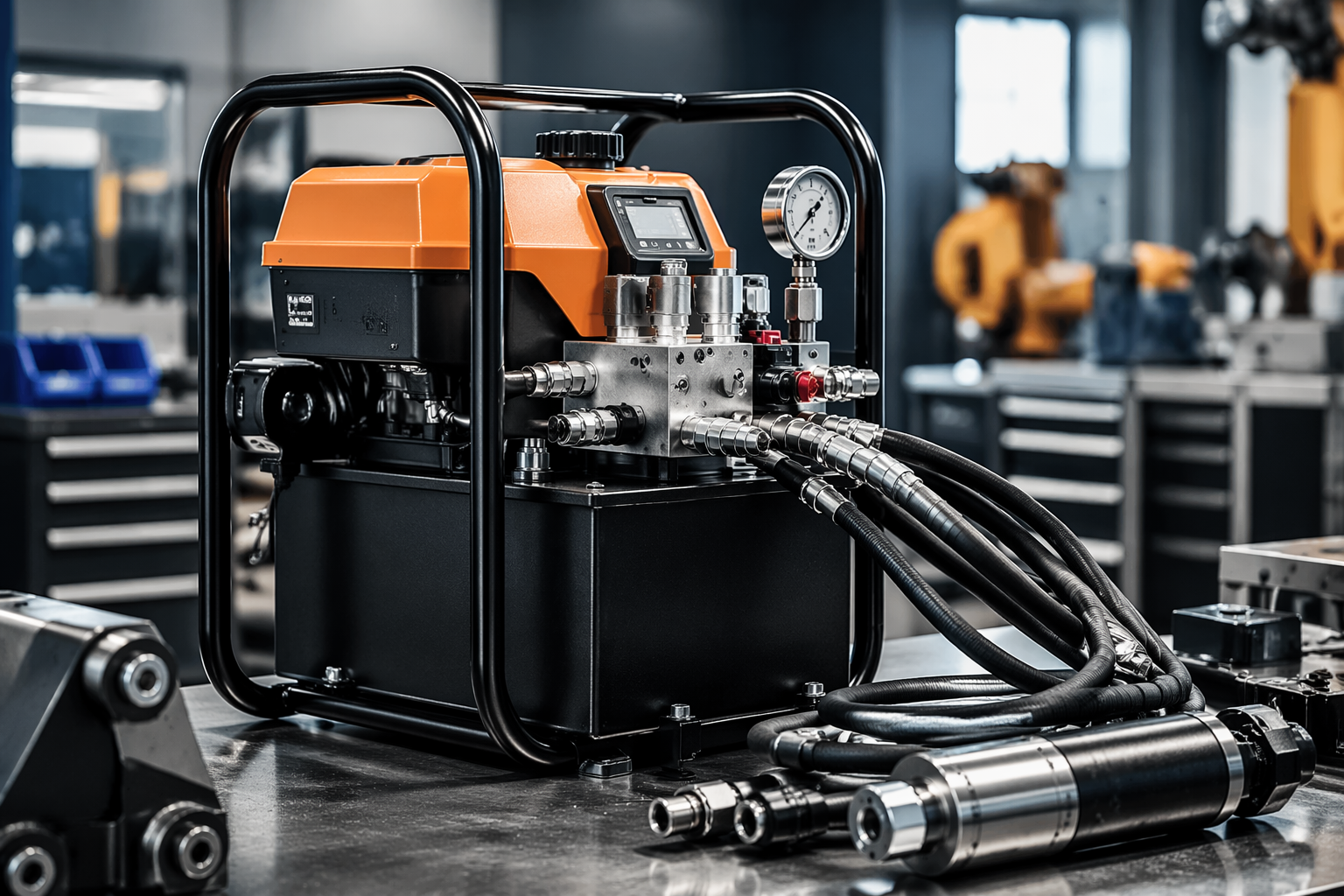
A battery hydraulic pump converts electrical energy stored in a 12V, 24V, 48V, or 60V battery platform into hydraulic energy by driving a motor connected to a pump assembly. That assembly pressurizes hydraulic fluid and delivers it to hydraulic cylinders, motors, or tools through valves and hoses. In practical field use, the most common buyer priorities are pressure, flow, runtime, recharge time, valve type, duty cycle, weight, and compatibility with existing hydraulic tools.
As Michael Lewis, a fluid power application specialist, states: “In portable hydraulics, pressure rating alone does not define performance; buyers must evaluate flow at working pressure, duty cycle, and how the pump integrates with the intended cylinder or tool.” That is especially important because many cordless units advertise high peak pressure but provide different GPM output depending on load stage.
A typical two-stage high pressure battery hydraulic pump operates with higher flow at low pressure and lower flow at high pressure. For example, a unit may deliver faster oil transfer during tool approach, then automatically switch to a lower-flow, high pressure stage for lifting, pressing, or torque applications. In battery-driven systems, this architecture helps preserve runtime while still supporting demanding work.
According to SAE International guidance on mobile hydraulic system design principles, selecting the correct pump requires balancing system pressure, flow demand, heat generation, and component matching. In simple terms, pressure measured in PSI determines force potential, while flow measured in GPM affects speed. A buyer seeking a battery powered hydraulic jack for occasional lift tasks may prioritize pressure and portability. A user powering repeated actuation cycles may need better continuous-flow performance and battery endurance.
According to ISO, consistent component quality and documented process control are essential for safe, repeatable industrial equipment performance. That is why serious buyers look for manufacturing systems tied to ISO 9001 quality management, traceable testing, and compatibility with recognized seals, valves, hose assemblies, and control systems.
As David Chen, an industrial hydraulic systems engineer, states: “The best battery hydraulic pump is not always the one with the highest Volt rating; it is the unit that delivers stable high pressure, predictable runtime, and reliable valve response in real operating conditions.” This distinction matters for those comparing 60V products against lower-voltage alternatives. Higher voltage platforms can improve motor efficiency and power density, but final performance depends on the full system design, including motor controller, pump geometry, hydraulic fluid path, and thermal management.
According to IBISWorld, industrial equipment buyers are increasingly favoring solutions that reduce setup complexity and labor time, especially in maintenance-intensive sectors. That trend supports growing adoption of battery powered hydraulic equipment where crews need to move quickly between jobs. For example, in utility service or railway maintenance, a portable pump can eliminate generator setup, extension cords, or air lines. In water-related work, while a submersible water pump serves a different function than a hydraulic unit, procurement teams often evaluate both under the same mobility and off-grid power criteria.
When comparing specifications, buyers should review:
1. Pressure rating: Many high pressure units target 10,000 PSI for compatibility with common industrial cylinders and tools.
2. Flow rate: Check no-load and full-load GPM performance, not just peak values.
3. Valve configuration: Manual, solenoid, dump, 3-way, and 4-way valves support different tool motions.
4. Reservoir size: Must match cylinder volume requirements.
5. Battery ecosystem: Runtime, recharge speed, and spare pack availability affect uptime.
6. Duty cycle and temperature: Continuous versus intermittent use changes pump selection.
This is also where POOCCA can add value. Beyond standard hydraulic pumps, POOCCA supports custom solutions for pressure, flow, valve layouts, and OEM integration, which is important for buyers who need application-specific hydraulic power rather than a one-size-fits-all catalog model.
Industry Standards and Compliance: What Serious Buyers Should Verify
For industrial procurement, performance claims are only part of the story. A battery hydraulic pump used in lifting, maintenance, pressing, or remote service must also align with recognized standards and documentation practices. This reduces risk, supports equipment acceptance, and helps protect operators.
The first checkpoint is ISO 9001. ISO 9001 does not certify a pump’s pressure output directly, but it confirms that the manufacturer follows a structured quality management system covering process control, inspection, corrective action, and traceability. According to ISO, organizations implementing ISO 9001 aim to improve consistency and customer satisfaction through documented operational discipline. For hydraulic buyers, that matters because component variation can affect sealing, valve response, leakage, noise, and long-term durability.
The second checkpoint is CE marking for products entering relevant markets. CE marking indicates that a product conforms to applicable European safety, health, and environmental requirements. For a battery powered hydraulic power unit, this may involve electrical safety, EMC considerations, and machinery-related directives depending on configuration and intended use.
Third, buyers should evaluate references to SAE International standards where applicable, especially for hose performance, fittings, pressure integrity, and mobile hydraulic best practices. Hose compatibility is crucial in 10,000 PSI systems because even a strong pump becomes a liability if the connected hose, coupler, or fitting is underrated or improperly matched.
Fourth, the NFPA framework is important in North American fluid power environments. NFPA publications help guide system safety, terminology, and design understanding. According to NFPA, proper system design includes pressure relief, secure connections, and operator awareness of stored hydraulic energy. In field conditions, battery-powered convenience should never compromise pressure safety.
Fifth, buyers in oil and gas or certain heavy industrial sectors may also ask about API standards relevance. While not every portable battery hydraulic pump falls under direct API product scope, API-oriented procurement teams often expect robust documentation, material consistency, and reliability aligned with severe-service expectations.
As Sarah Mitchell, a compliance manager in industrial equipment sourcing, states: “For hydraulic procurement, documentation is part of performance. A pump with verified testing, quality records, and clear compliance markings lowers downstream operational risk.” That is especially true for multinational buyers, distributors, and OEMs who need consistent paperwork across shipments.
In practical terms, a compliant sourcing checklist should include pressure test records, battery safety documentation, valve function verification, reservoir cleanliness control, user manual clarity, spare parts support, and warranty terms. For organizations scaling product lines or entering new markets, sourcing from a partner like POOCCA can simplify custom requirements thanks to factory-direct coordination, flexible MOQ, and manufacturing support tied to recognized quality systems.
Implementation Guide: How to Select the Right Battery Hydraulic Pump
Choosing the right battery hydraulic pump starts with the application, not the marketing headline. Buyers should begin by identifying the tool or actuator being powered: hydraulic cylinder, nut splitter, torque wrench, battery powered hydraulic jack, rescue tool, clamp, or specialty fixture. Then calculate required PSI, oil volume, cycle frequency, and expected runtime.
According to Markets and Markets, maintenance optimization and mobile service efficiency are key industrial investment themes, with buyers increasingly preferring equipment that reduces downtime and supports field responsiveness. In practice, that means a pump that starts instantly, travels easily, and does not require external infrastructure can improve total job productivity.
Here is a practical implementation framework:
Step 1: Define pressure need. If your cylinder or tool requires 10,000 PSI, do not underbuy with a lower-rated unit.
Step 2: Calculate oil volume. Ensure reservoir capacity supports full extension and return cycles.
Step 3: Match flow to speed. If cycle time matters, compare GPM at actual working pressure.
Step 4: Choose voltage platform. 12/24/48/60V options differ in size, runtime, and power delivery.
Step 5: Evaluate battery logistics. Spare packs, charger speed, and field-swappable designs affect uptime.
Step 6: Confirm valve requirements. Single-acting and double-acting tools need different control schemes.
According to Statista, industrial battery demand continues to rise alongside electrification trends, which benefits portable tool ecosystems by expanding battery technology and availability. However, more Volt does not automatically mean better fit. A smaller 24V or 48V unit may be sufficient for intermittent service, while 60V systems can be attractive where repeated high-load cycles require stronger power density.
Success also depends on total cost factors. A battery hydraulic pump may carry a higher initial purchase price than a basic manual or corded alternative, but it can reduce labor, setup time, and dependence on generators or compressors. In remote maintenance, even one avoided service delay can justify the premium. Buyers searching related terms like battery hydraulic pump kit, battery hydraulic pump price, Milwaukee Battery Hydraulic Pump, battery hydraulic pump enerpac, or 10,000 PSI hydraulic pump should compare complete packages, not just base units. Look at included battery, charger, hose, couplers, frame protection, and service support.
For distributors and OEMs, POOCCA is especially relevant when standard catalog products do not align with local market needs. Factory-direct pricing can improve margin, flexible MOQ reduces inventory pressure, and custom solutions support branding, porting, mounting, and hydraulic performance adjustments. That combination is useful for buyers serving construction, water management support systems, transport maintenance, and industrial service markets where application diversity is high.
Future Outlook: Where Battery Hydraulic Power Is Heading
The future of the battery hydraulic pump market is closely tied to three trends: industrial electrification, mobile service efficiency, and smarter hydraulic controls. According to Grand View Research, demand for energy-efficient industrial equipment and compact power solutions is helping reshape equipment design across multiple sectors. At the same time, according to Statista, battery technology investment continues to accelerate globally, improving power density, charging performance, and lifecycle economics.
For buyers, this means the next generation of battery powered hydraulic equipment will likely offer better runtime, lighter weight, smarter battery management, and improved connectivity for service diagnostics. Expect more application-specific units for lifting, crimping, rescue, torque, and remote maintenance rather than generic one-size-fits-all systems. We will also likely see broader crossover between hydraulic service tools and adjacent mobile equipment categories, including transfer pumps and specialized water pump support gear in field operations.
In the near term, 60V platforms will remain attractive for users needing strong high pressure performance in a cordless format, but 12/24/48V products will still serve lighter-duty or more compact installations. The smartest procurement strategy is to source from a manufacturer that can adapt to changing requirements while maintaining technical documentation and consistent quality. If your team is evaluating a battery hydraulic pump for OEM, distribution, or industrial end use, exploring custom, factory-direct options through POOCCA is a practical next step.
Frequently Asked Questions
How long will a 60V battery last?
Battery life depends on load, pressure, flow demand, ambient temperature, and how often the pump cycles between low- and high-pressure stages. In real hydraulic use, runtime is usually measured either in continuous minutes or number of cycles rather than simple battery hours. For high pressure cordless pumps, a 60V platform is often selected because it supports better power density and can sustain demanding hydraulic work more effectively than lower-voltage alternatives in similar size classes. According to Statista, ongoing growth in industrial battery technology is improving energy density and recharge performance, which helps extend usable field runtime. In practice, many users should expect a 60V battery hydraulic pump to deliver enough energy for intermittent service tasks such as cylinder actuation, bolt tensioning, or jack operation across multiple cycles. However, if the tool spends most of its time at 10,000 PSI, runtime will be lower than at light load. Buyers should always ask for cycle counts at defined pressure and oil volume, not just generic claims. It is also wise to consider spare battery packs, charger speed, and whether the pump supports quick battery swaps for continuous work across a shift.
What pump runs without electricity?
Several pump types can operate without direct grid electricity. In hydraulics, common examples include manual hand pumps, air-driven hydraulic pumps powered by compressed air, engine-driven hydraulic pumps, and battery powered hydraulic pumps. A manual pump is the simplest option and works well for low-frequency tasks, but it is slower and physically demanding for repeated cycles. Pneumatic pumps avoid electrical cords but require an air compressor and hoses. Gas-powered units are suitable for some outdoor environments but produce noise, emissions, and fuel handling requirements. Battery hydraulic pumps are increasingly popular because they avoid direct wall electricity while still delivering high pressure output in a portable format. According to NFPA, fluid power remains valuable where compact equipment must generate substantial force reliably, which is why portable power options are growing in importance. For jobs in construction, MRO, transport, and emergency field service, a battery powered solution often provides the best balance of force, mobility, and ease of use. Buyers should still assess whether the application needs continuous operation, high flow, or only occasional pressure generation, because those factors determine whether a manual, pneumatic, engine-driven, or battery option is best.
What is the flow rate of a 60 hp pump?
There is no single flow rate for a 60 hp pump because horsepower alone does not determine output. Flow rate depends on pump displacement, speed, system efficiency, and operating pressure. In hydraulic systems, flow is commonly expressed in GPM, while pressure is expressed in PSI. A high horsepower pump can produce high flow, high pressure, or a combination of both depending on design. According to SAE International, correct hydraulic selection requires balancing pressure and flow with application demand rather than relying on one headline metric. For example, a high pressure hydraulic pump intended for 10,000 PSI tool use may have relatively modest GPM because force matters more than speed, while a lower-pressure transfer or water pump may emphasize much higher flow. That distinction is important for buyers who are searching broad terms like power pump, water pump, submersible pump, or hydraulic pump at the same time. If you are selecting a battery hydraulic pump, focus first on your cylinder volume and required cycle time. Then ask the supplier for flow at both no-load and rated pressure, because those numbers determine real operating speed much more accurately than horsepower alone.
Is there a 60 volt battery?
Yes. 60V battery platforms are widely available in industrial tools, outdoor power equipment, and some portable hydraulic applications. In many cases, the marketed “60V” label refers to nominal or maximum voltage conventions used by manufacturers, so buyers should read the technical specifications carefully. For portable hydraulics, a 60V battery can provide strong power density, which helps the motor drive a pump capable of generating high hydraulic pressure. According to Markets and Markets, equipment electrification continues to expand across industrial sectors, increasing demand for more capable battery-powered systems. This trend supports the adoption of 60V cordless hydraulic pumps where users need mobility without sacrificing output. That said, the ideal battery voltage still depends on workload. A 12V or 24V unit may be enough for lighter or vehicle-based applications, while 48V and 60V systems are often better for repeated high-pressure tasks. Buyers should compare not just voltage, but also amp-hour capacity, battery chemistry, charger compatibility, thermal management, and the overall efficiency of the motor-pump assembly. A well-designed 48V system may outperform a poorly designed 60V system in actual field use.
What should I look for in the best 60V battery powered pumps?
The best 60V battery powered pumps combine high pressure capability, practical runtime, robust safety features, and compatibility with the intended hydraulic tools. For a battery hydraulic pump, key criteria include maximum PSI, GPM at working pressure, reservoir capacity, valve configuration, frame durability, battery swap convenience, and quality documentation. According to ISO, consistent process control and documented quality systems are vital for reliable industrial equipment manufacturing, which is why ISO 9001-backed production is an important procurement factor. You should also confirm CE marking where relevant, rated hose and coupler compatibility, and support for single-acting or double-acting cylinders as needed. If you are comparing options against known market searches like Milwaukee Hydraulic Pump Kit, battery hydraulic pump kit, or Battery powered Hydraulic Jack, look beyond brand familiarity and review complete application fit. Ask whether the pump includes battery and charger, how many cycles it can complete at high pressure, what the noise level is, and whether replacement parts are available. For distributors and OEM buyers, custom branding, factory-direct pricing, and flexible MOQ can also be major advantages when selecting a supply partner.
Are battery powered hydraulic jacks and cordless sump or transfer pumps the same thing?
No. A battery powered hydraulic jack and a cordless sump pump or transfer pump serve different functions even though buyers may discover them through similar search behavior. A hydraulic jack uses pressurized hydraulic fluid to multiply force and lift heavy loads. It typically requires high pressure and relatively low flow. A sump pump or transfer pump moves water or other fluids and usually prioritizes flow rate rather than pressure force. A submersible water pump is specifically designed to operate in liquid, while a battery hydraulic pump is designed to power hydraulic cylinders, tools, or jacks through a closed fluid power circuit. According to Grand View Research, industrial demand is rising for specialized equipment designed around specific application needs rather than broad multiuse compromise products. That is why buyers should separate lifting, pressing, torque, and actuation needs from dewatering or transfer needs. If your job involves lifting or powering hydraulic tools, choose a high pressure hydraulic pump. If your job involves draining pits, moving water, or liquid transfer, choose a transfer or sump pump. Clarifying this difference helps avoid costly procurement mistakes and ensures the equipment matches the required output and operating environment.