 English
 Russian
 Arabic
 Indonesian
 Turkish
 Vietnamese
 Polish
 German
 Malay
Malay Thai
Thai Kazakh
 Spanish
 Chinese (Simplified)
 Korean
 Italian
 Azerbaijani
 Dutch
Dutch French
 Romanian
 Portuguese
 Hindi
HindiAccording to Grand View Research, the global hydraulic equipment market was valued in the multi-billion-dollar range in recent years and is projected to expand at a steady CAGR through the next decade, reflecting continued demand for hydraulic pumps, cylinders, valves, and motors across construction, manufacturing, energy, and maintenance operations. In that environment, the single acting hydraulic hand pump remains a practical, cost-effective, and highly reliable solution for controlled force generation where portability, simplicity, and safety matter most.
Unlike a broad industrial catalog page that mainly helps buyers compare listings, this guide is designed to help engineers, OEM purchasers, distributors, and maintenance teams understand how a single acting hydraulic pump works, where it fits, how to evaluate performance, and what standards to verify before ordering. Whether you are replacing a manual unit, specifying a compact power source for a hydraulic cylinder, or comparing a single stage versus multi-stage design, the goal is to support better technical and commercial decisions.
1. Industry Context: Why Single Acting Hydraulic Hand Pumps Still Matter in Modern B2B Procurement
The market conversation around hydraulic technology often focuses on advanced electric power units, variable displacement piston pump systems, and digitally monitored fluid power platforms. Yet manual pumps still occupy an important space because they solve a different problem: delivering dependable hydraulic force without requiring electric power, compressed air, or complex controls. For field maintenance, lifting, bolt tensioning, press operations, rescue tools, and low-duty intermittent applications, a single acting hydraulic hand pump offers excellent utility with minimal infrastructure.
According to Markets and Markets, the fluid power equipment market continues to grow as industrial automation, heavy equipment demand, and energy-sector maintenance increase globally. That matters because even in highly automated plants, technicians still need portable tools for setup, emergency actuation, testing, and service operations. A manual hydraulic pump is often the most efficient answer when the job requires precision pressure rather than continuous flow.
According to Statista, global manufacturing output has shown resilient long-term expansion despite regional fluctuations, supporting sustained demand for maintenance tools and compact hydraulic power solutions. In practice, that means buyers are not just searching for a generic hydraulic pump; they are searching for a reliable, application-specific unit with the right PSI rating, reservoir size, handle effort, and compatibility with single acting cylinders.
Single acting hand pumps are especially relevant in applications where hydraulic fluid is used to extend a cylinder under pressure and a spring or gravity return brings it back. This reduces circuit complexity and makes the overall system easier to maintain. Compared with an electric hydraulic power unit, a hand-operated model can be lighter, easier to transport, and more economical for intermittent use. In many MRO environments, that translates directly into lower total cost of ownership.
For B2B buyers, supplier selection is equally important. Manufacturers that can provide custom reservoir volumes, pressure calibration, hose and coupler matching, and flexible production support have a clear advantage. This is where POOCCA stands out as a factory-direct hydraulic supplier focused on custom solutions, ISO 9001-oriented quality management, flexible MOQ, and value-driven sourcing for distributors and OEM customers. Instead of only offering a catalog listing, a capable supplier should help confirm cylinder compatibility, required pressure, stroke volume, and application fit before production or shipment.
2. Technical Deep Dive: How a Single Acting Hydraulic Hand Pump Works and What Buyers Should Compare
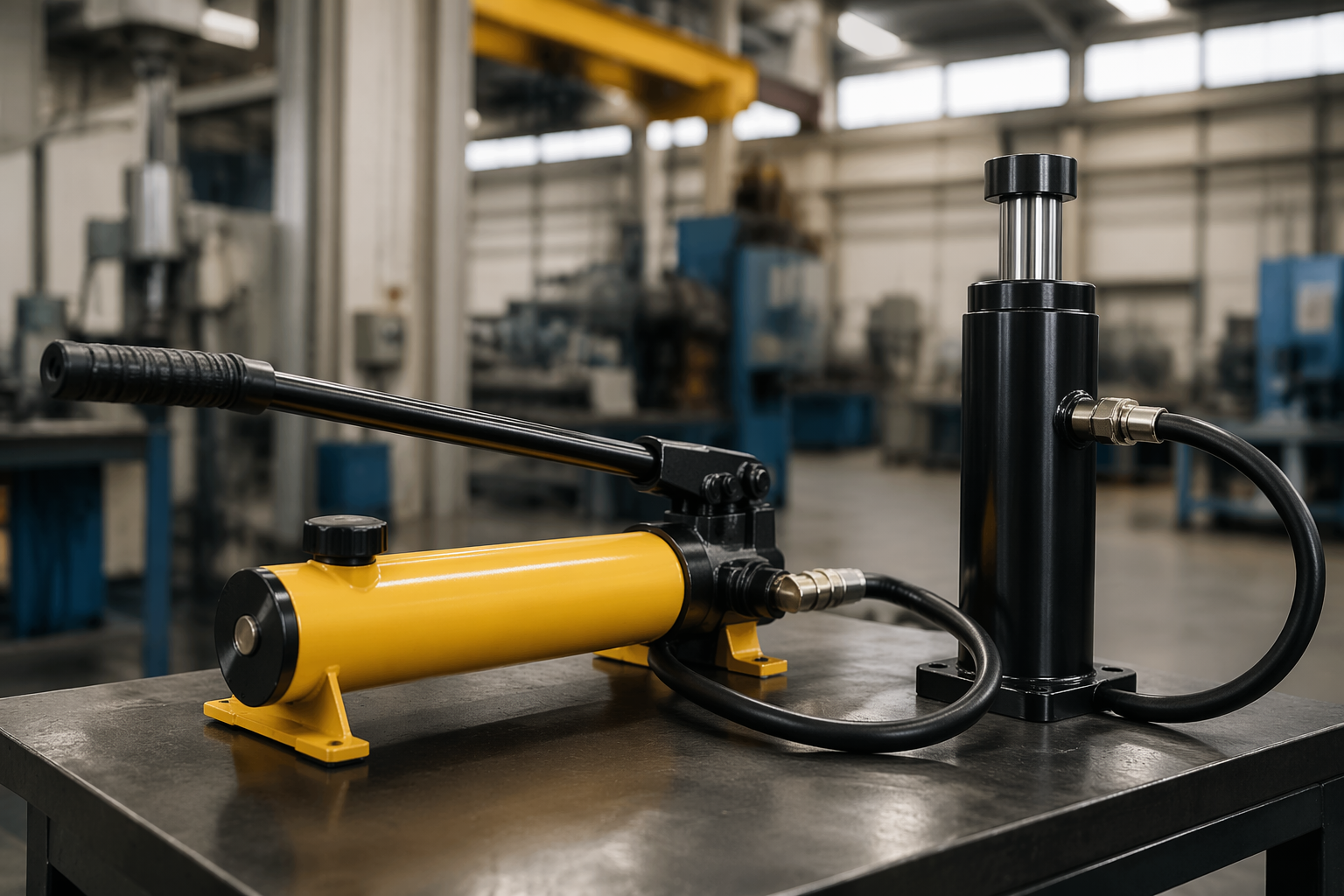
A single acting hydraulic hand pump converts manual force into hydraulic pressure through a piston mechanism inside the pump body. When the operator moves the handle, the internal piston displaces hydraulic oil from the reservoir into the pressure line, sending fluid to a single acting hydraulic cylinder. The cylinder extends under pressure. When the release valve is opened, pressure is relieved and the cylinder retracts through an external load, spring return, or gravity.
The most important technical parameters are pressure (PSI), flow rate, reservoir capacity, stage configuration, valve quality, sealing performance, and compatibility with the cylinder or tool being actuated. Many industrial hand pumps are rated up to 10,000 PSI, which is common in maintenance, lifting, and bolting applications. Flow in manual systems is not usually discussed the same way as in powered units, but understanding volume per stroke is still essential because it determines how quickly the cylinder extends.
According to NFPA fluid power guidance, proper component sizing and pressure control are critical to safe and efficient hydraulic system operation. In a practical sense, if a pump is matched poorly to a cylinder volume, users may experience slow extension, excessive operator effort, or incomplete stroke. This is one reason buyers should compare not just maximum pressure, but also first-stage and second-stage delivery characteristics in a two-stage model.
As Mike Carlson, a senior fluid power application engineer, states: “A hydraulic hand pump should never be selected on pressure rating alone; usable oil volume, valve control, and cylinder matching determine real-world performance.” That point is especially relevant when users search terms such as best single acting hydraulic hand pump or hydraulic hand pump 10,000 psi. A 10,000 PSI rating sounds impressive, but if the pump displacement is too low for the required stroke, productivity suffers.
According to SAE International technical references, maintaining proper fluid cleanliness and matching component pressure classes can significantly reduce premature seal wear and internal leakage in hydraulic systems. In portable manual circuits, contamination often enters during filling, hose changes, or field handling. That is why buyers should prioritize robust sealing, durable check valves, corrosion-resistant materials, and clearly specified maintenance procedures.
From a design standpoint, a single stage pump is simple and economical, while a two-stage pump provides higher low-pressure volume followed by high-pressure capability at reduced flow. This improves efficiency when the cylinder must travel quickly to contact the load and then build pressure for the working stroke. In other words, a two-stage acting pump can reduce manual effort and cycle time, especially with larger cylinders.
As Dr. Robert Klein, hydraulic systems consultant, states: “For intermittent force generation, a well-built manual pump remains one of the most reliable power sources because it avoids many of the failure modes associated with electric drives and complex controls.” That reliability is a major reason why manual pumps remain relevant across industrial service operations.
Buyers should also examine connections to the broader hydraulic system. Even if the pump itself is manual, the working circuit still depends on the integrity of the cylinder, hoses, couplers, valves, and in some systems downstream motors or manifolds. According to IBISWorld, industrial equipment buyers increasingly prioritize supplier responsiveness, product consistency, and after-sales support alongside price. That trend favors manufacturers able to discuss real application conditions instead of merely publishing a model number. For companies seeking factory-direct support, POOCCA can assist with custom solutions, pressure range confirmation, and procurement planning for B2B orders.
3. Industry Standards and Compliance: ISO, SAE, NFPA, CE Marking, and API Considerations
In hydraulic procurement, performance claims are important, but compliance and manufacturing discipline are often what separate a dependable industrial product from a risky purchase. Buyers evaluating a single acting hydraulic hand pump should verify whether the manufacturer follows recognized quality systems and whether the product aligns with relevant application and export requirements.
The first checkpoint is ISO 9001. ISO 9001 does not certify the hydraulic performance of a pump directly, but it does indicate that the manufacturer follows a documented quality management system covering process control, traceability, corrective action, and continuous improvement. According to ISO, over one million management system certificates have been issued globally across various standards families, underscoring how central standardized quality processes have become in industrial sourcing. For importers, distributors, and OEMs, this matters because consistency across batches is crucial for seals, pressure performance, leak testing, and dimensional tolerances.
Second, buyers should consider CE marking where applicable for products entering regulated markets. CE requirements vary by product category and intended use, so importers should confirm whether the pump, associated assemblies, or complete hydraulic power package fall under applicable directives or regulations. Documentation quality, labeling, and user instructions are all part of responsible market access.
Third, SAE International references are highly relevant when reviewing hydraulic connectors, hose interfaces, pressure classes, and fluid power design practices. Standardized ports and fittings reduce installation risk and improve replacement compatibility. In field service applications, mismatch at the fitting level can create downtime, leakage, or unsafe operation even when the pump itself is high quality.
NFPA guidance is also important in North American fluid power applications, especially for safe system design, terminology, and component selection logic. While NFPA standards and recommendations do not replace engineering judgment, they offer a useful framework for matching pumps, valves, cylinders, and pressure control devices correctly.
For oil and energy-related applications, buyers may also encounter requirements linked to API standards, particularly when hydraulic tools or pressure-generating equipment are used in upstream, midstream, or plant maintenance environments. Even if a hand pump is not itself API-certified, project owners may expect supplier documentation, material traceability, and compatibility with broader site standards.
These compliance factors should be part of any RFQ evaluation. A serious supplier should be prepared to discuss pressure testing, inspection workflow, material selection, seal options, labeling, packaging, and export documentation. This is another area where POOCCA offers procurement value through factory-direct communication, custom configuration support, and quality-oriented production practices aligned with international B2B expectations.
4. Implementation Guide: How to Select the Right Model, Pressure Range, and Configuration
Selecting the right single acting hydraulic hand pump starts with the load and the cylinder. First, determine the required force. Second, identify the cylinder bore and stroke. Third, calculate the pressure needed to generate the force. Fourth, match the pump reservoir and displacement to the cylinder volume so the system can complete the intended stroke without refilling or excessive handle cycles.
For example, a maintenance team using a spring-return cylinder for flange spreading or controlled lifting may require up to 10,000 PSI but only intermittent duty. In that case, a compact manual pump with a durable release valve, easy-carry design, and sufficient usable oil volume may outperform a bulkier electric unit on cost and mobility. By contrast, if the tool will cycle repeatedly throughout the day, an electric hydraulic power unit may be more productive.
According to Statista, industrial buyers increasingly use digital channels to research technical products before contacting suppliers, which means product pages and articles must answer both search intent and engineering intent. This is why implementation content should include practical decision criteria: hand force, reservoir vent design, horizontal or vertical operation, corrosion resistance, hose length, pressure gauge requirement, and coupler type.
One common comparison is single acting versus double acting hand pumps. A single acting pump typically powers one direction of cylinder motion and relies on spring or load return. A double acting design sends hydraulic fluid in both directions, enabling powered extension and retraction. The single acting option is usually simpler, lighter, and easier to maintain, while the double acting version offers more control for applications requiring active return force.
According to Markets and Markets, demand for compact, efficient industrial equipment continues to rise as manufacturers seek lower operating complexity and improved maintenance productivity. In practice, many users find that the best manual unit is not the most powerful on paper, but the one that reduces setup time, operator fatigue, and service interruptions.
When evaluating suppliers, ask for pressure test procedures, seal material options, exploded drawings, and recommended hydraulic oil specifications. Also ask whether the manufacturer can support private labeling, custom color, packaging, or accessory bundling. Those details matter for distributors and OEMs building a differentiated offer in the market. Buyers that need flexible MOQ and direct factory communication can contact POOCCA to discuss tailored hydraulic pump and component sourcing.
5. Future Outlook: Market Demand, Product Evolution, and Smart Procurement Strategy
The future of the hydraulic sector will be shaped by automation, electrification, sustainability, and smarter maintenance—but manual pumps are unlikely to disappear. Instead, their role will become more specialized and more quality-sensitive. According to Grand View Research, continued infrastructure activity, industrial maintenance demand, and equipment modernization will support ongoing market opportunities for hydraulic components and portable force tools.
We can also expect product evolution in ergonomics, lightweight materials, sealing reliability, and integrated safety features. Better handle geometry, improved valve response, more efficient two-stage circuits, and cleaner documentation will make manual hydraulic pumps easier to deploy in field service and industrial maintenance contexts. At the same time, buyers will increasingly expect fast quotation turnaround, export-ready packaging, and application-specific customization.
For procurement teams, the smartest strategy is to treat a single acting hydraulic hand pump not as a generic commodity, but as part of a working hydraulic system that includes cylinders, valves, hoses, couplers, pumps, and sometimes motors in adjacent equipment. Selecting the right supplier means balancing technical reliability, standards alignment, lead time, support, and price. If your team is comparing models for distribution, OEM integration, or industrial maintenance projects, a factory-direct partner such as POOCCA can help streamline selection with custom solutions and practical B2B support.
Frequently Asked Questions
Who makes the best hydraulic pumps?
The best hydraulic pumps are made by companies that combine application knowledge, manufacturing consistency, and strong after-sales support—not just a recognized brand name. In heavy industry, buyers usually compare product range, pressure capability, service life, lead time, standards compliance, and availability of matching components such as hydraulic cylinders, valves, and motors. According to IBISWorld, industrial buyers are increasingly influenced by supplier reliability and fulfillment performance, not only unit price. That means the “best” supplier depends on your use case: mobile equipment, factory machinery, maintenance tools, or OEM integration.
For manual and compact hydraulic applications, the best manufacturer is often one that can provide verified PSI ratings, stable seal performance, clear maintenance guidance, and custom options. If you are sourcing a single acting hydraulic hand pump, ask whether the supplier supports ISO 9001-aligned quality processes, offers CE-related documentation where needed, and can match hose and coupler configurations. A supplier that helps with application sizing is more valuable than one that only lists models online.
In B2B sourcing, many buyers also value factory-direct pricing and flexible MOQ. Those factors can be critical for distributors, private label programs, and OEMs testing a new market. Rather than assuming one global brand is always best, compare technical fit, documentation quality, and responsiveness to your actual operating conditions.
Who is the world’s largest pump manufacturer?
The answer depends on whether you mean pumps broadly—such as water pumps, industrial process pumps, and building services pumps—or hydraulic pumps specifically. The global pump market is diverse, with leadership varying by segment, geography, and application. According to Statista, the industrial manufacturing landscape includes multiple multinational pump groups with major revenues across fluid handling categories, but hydraulic pump specialization is a narrower field than the total pump industry.
For buyers in the hydraulic sector, the more useful question is not simply who is the largest, but who is most suitable for your requirement. A very large multinational may offer broad product coverage, but not always the fastest customization or most flexible order structure for a niche need like a single acting hand pump or a custom hydraulic power unit. In contrast, a focused hydraulic manufacturer may offer stronger technical communication and better adaptation to your target pressure, reservoir size, and connection standards.
If your procurement goal includes competitive lead times, custom branding, or application-specific configuration, evaluate supplier capability beyond company size. Ask about testing, materials, sealing systems, compliance, and support for accessories. For many industrial buyers, the ideal supplier is not necessarily the biggest company, but the one that can deliver reliable hydraulic performance with the right commercial flexibility.
What is a single-acting hydraulic pump?
A single-acting hydraulic pump is a pump designed to send hydraulic fluid in one powered direction to operate a single acting cylinder or tool. In the most common setup, the pump pressurizes fluid to extend the cylinder, and the return motion happens through a spring, gravity, or external load after the pressure is released. This is why single acting systems are generally simpler than double acting systems, which require hydraulic power in both directions.
In a manual configuration, a single acting hydraulic hand pump uses a lever handle and internal piston to generate hydraulic pressure. These pumps are widely used in maintenance, lifting, tensioning, pressing, and rescue applications because they are portable, dependable, and do not need an electric power source. Many are designed for pressures up to 10,000 PSI. According to NFPA guidance, proper matching of pressure source and actuator is essential for safe and effective operation, especially in compact hydraulic circuits.
The key advantages of a single acting pump are simplicity, lower system complexity, easier maintenance, and strong suitability for intermittent tasks. The main limitation is that it does not actively power retraction in the same way a double acting system does. For many industrial jobs, however, that tradeoff is entirely acceptable and even preferable due to lower cost and easier setup.
Who is the biggest hydraulic company?
There is no single universal answer because the hydraulic industry includes many categories: pumps, valves, cylinders, motors, power units, mobile hydraulics, industrial hydraulics, and complete motion-control systems. Company size can be measured by revenue, installed base, regional presence, or market share within a specific product line. According to Markets and Markets, growth in fluid power is supported by construction, agriculture, manufacturing, and energy applications, which means leadership varies across sectors.
For procurement teams, the identity of the biggest hydraulic company is usually less important than supplier fit. A large hydraulic company may offer strong brand recognition and broad distribution, but a specialized or factory-direct supplier may provide better responsiveness for custom projects, pilot orders, and private label needs. That is particularly relevant for products like single acting hydraulic hand pumps, where application details such as stroke volume, release valve design, and coupler compatibility can matter more than logo recognition alone.
When comparing suppliers, request data on maximum pressure, pressure hold performance, leak testing, material quality, and production consistency. Also review whether the supplier can support your market with documentation, export packaging, and MOQ flexibility. In B2B hydraulics, “biggest” does not always equal “best fit.”
What is the difference between single acting and double acting hand pumps?
The difference between single acting and double acting hand pumps is how hydraulic fluid is applied in the system. A single acting hand pump delivers fluid pressure for one powered movement, usually cylinder extension, while retraction occurs by spring return, gravity, or external force. A double acting hand pump can direct fluid pressure for both extension and retraction, which gives the operator more controlled bidirectional movement.
From a system perspective, single acting designs are simpler. They often use fewer hydraulic lines, are easier to maintain, and are well suited to portable or intermittent applications. Double acting systems are more versatile when a load must be retracted positively or when precise motion control is required in both directions. According to SAE International design guidance, correct hose routing, fitting compatibility, and pressure matching are essential in either architecture to ensure safe operation and minimize leakage risk.
In commercial terms, single acting hand pumps are typically more economical and are common in maintenance tool kits, lifting tools, and basic service operations. Double acting pumps may justify their higher complexity when speed, repeatability, or active return force is necessary. The right choice depends on the actuator design and the working environment, not just on price or advertised PSI alone.
What are common problems with single-acting cylinders and pumps?
Common problems with single acting hydraulic cylinders and pumps include slow extension, pressure loss, oil leakage, air entrapment, incomplete retraction, and contamination-related wear. Many of these issues are not caused by a defective pump alone; they arise from poor system matching, damaged seals, incorrect hydraulic fluid, worn couplers, or improper bleeding. According to ISO-aligned quality principles, process control and documentation are key to reducing repeat failures in industrial equipment.
For example, if a hand pump cannot build pressure, the cause may be a release valve not fully seated, internal check valve wear, trapped air, or low oil level in the reservoir. If a single acting cylinder does not retract properly, the issue may stem from a weakened spring, side loading, contamination, or insufficient external return force. Excessive handle effort can indicate a pump that is undersized for the cylinder volume or operating too near its maximum pressure range.
Preventive maintenance matters. Keep fluid clean, inspect hoses and fittings, store the pump correctly, and verify compatibility between pump, cylinder, and accessories. Buyers should also choose suppliers that provide clear operating instructions and spare parts support. A well-built single acting hydraulic hand pump can be highly reliable, but only when installed, used, and maintained as part of a properly matched hydraulic system.